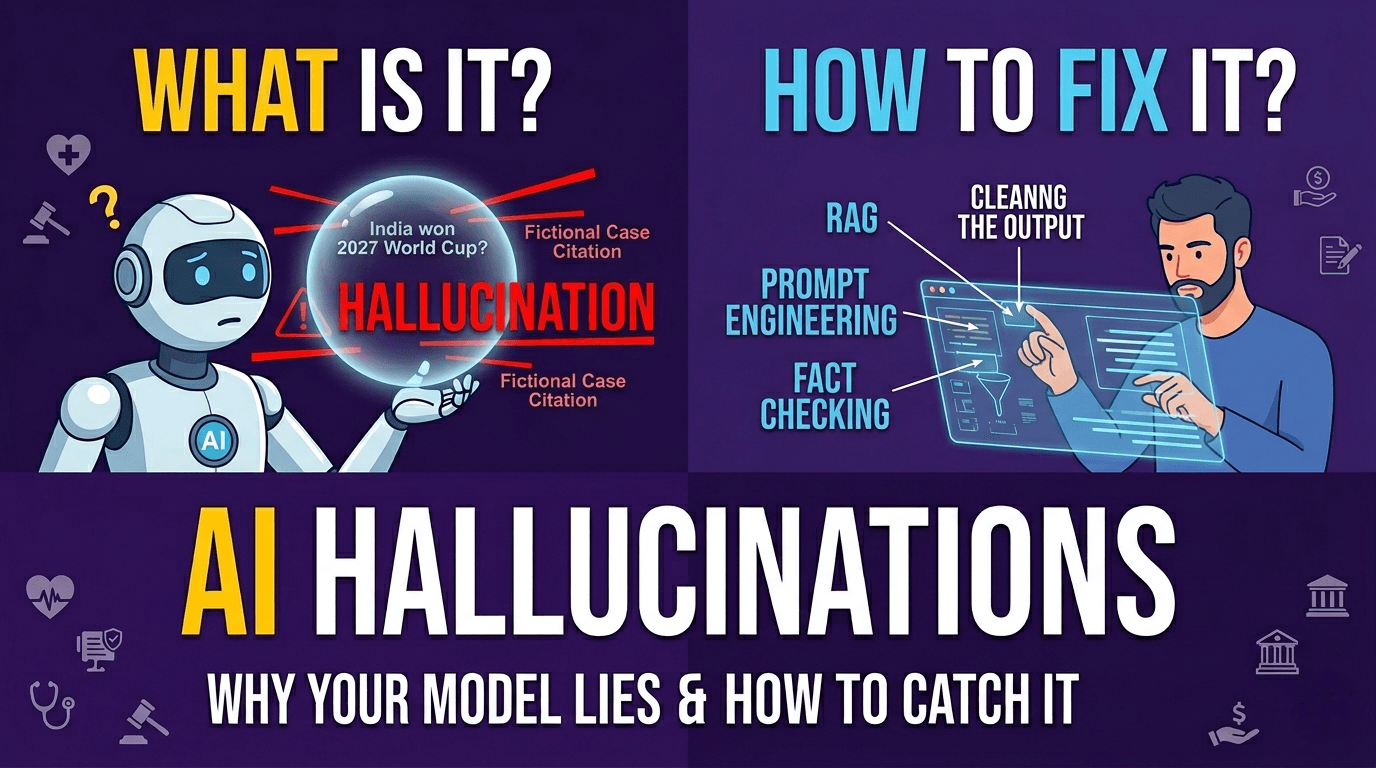
As AI/ML developers, we are not just building models - we are building systems that people trust. Understanding hallucinations is no longer optional knowledge; it is a core engineering responsibility. In this post, I'll break down what AI hallucinations actually are, why they happen under the hood, the different types you will encounter, and - most importantly - how to detect and reduce them in practice.
1. What Are AI Hallucinations?
In the context of Large Language Models (LLMs) and generative AI, a hallucination is when the model produces output that is factually incorrect, fabricated, or entirely nonsensical - yet presents it with high confidence as if it were true.
The term is borrowed from psychology, where hallucinations refer to perceiving things that do not exist. In AI, the analogy is apt: the model "perceives" and generates content that has no grounding in reality.
What makes hallucinations particularly dangerous is the confidence with which they are delivered. Unlike a simple error message or an "I don't know" response, a hallucinated answer looks and sounds just like a correct one.
2. Why Do Models Hallucinate? (The Technical Reality)
To understand why models hallucinate, you need to understand what they are actually doing. LLMs do not "know" facts in the way humans do. They are statistical text prediction machines. At every step, the model is answering one question: given all this context, what token is most likely to come next?
2.1 The Core Causes
- Training data gaps: The model was never exposed to the right information, so it fills the gap with plausible-sounding text.
- Pattern over-generalization: The model learned patterns too broadly and applies them in contexts where they do not fit.
- Conflation of similar facts: Two similar entities or events get blended together in the model's learned representations.
- Prompt-following pressure: The model is trained to be helpful and give an answer, so it generates something even when it should say "I don't know".
- Knowledge cutoff: The model has no awareness of events after its training cutoff date.
- Decoding strategy effects: High-temperature sampling, beam search, or nucleus sampling can push outputs toward creative but inaccurate territory.
Fundamentally, the model is not "lying" with intent. It has no notion of truth. It is pattern-matching at massive scale, and sometimes the most statistically likely pattern is wrong.
2.2 The RLHF Factor
Reinforcement Learning from Human Feedback (RLHF) - the technique used to make models more helpful and conversational - can actually amplify hallucinations. Why? Because human raters often prefer confident, fluent responses over hedged, uncertain ones. The model learns: sounding confident gets rewarded.
3. Types of Hallucinations
Not all hallucinations are the same. As developers, it helps to classify them so we can target mitigation strategies more precisely.
4. Real-World Impact - Why This Actually Matters
Hallucinations are not just a technical curiosity - they have real consequences across industries:
- Healthcare: AI tools that hallucinate drug interactions or dosage information can put patients at risk.
- Legal: Lawyers have already faced sanctions for submitting AI-generated briefs containing fabricated case citations (the Mata v. Avianca incident in 2023 is a landmark example).
- Finance: AI-generated financial analysis with hallucinated figures can mislead investment decisions.
- Customer Service: Chatbots that hallucinate product features or policies destroy trust and create liability.
- Code Generation: LLM-generated code that hallucinate API method names or security best practices introduce bugs and vulnerabilities.
5. How to Catch Hallucinations
This is where it gets practical. As developers and ML engineers, here are the techniques and strategies we can use to detect hallucinations in our systems.
5.1 Retrieval-Augmented Generation (RAG) + Grounding Checks
The single most effective architectural change you can make is grounding your model's outputs in verified external sources using RAG. Instead of relying on the model's parametric memory, you retrieve relevant documents and instruct the model to answer from them.
Then, post-generate, you can check whether the model's answer is actually supported by the retrieved context.
5.2 Consistency Sampling (Self-Consistency Check)
Run the same prompt multiple times with temperature > 0. If the model is confident and factually grounded, its answers should be consistent. High variance across runs is a strong signal of hallucination risk.
5.3 LLM-as-Judge / Self-Evaluation
You can use a second LLM call (or even the same model) to evaluate whether an output is factually consistent with a provided reference. Prompt patterns like:
"Given the following context: [CONTEXT]\n Does this answer: [ANSWER]\n contradict, support, or go beyond the context? Answer: SUPPORT / CONTRADICT / UNSUPPORTED"
This turns factual verification into a classification problem that can be automated at scale.
5.4 Factuality Scoring with NLI Models
Natural Language Inference (NLI) models (like DeBERTa fine-tuned on NLI benchmarks) can evaluate whether a hypothesis (the model's answer) is entailed by a premise (the source document). Libraries like TruLens, RAGAS, and DeepEval provide ready-to-use hallucination metrics built on this approach.
5.5 Knowledge Graph Grounding
For structured domains (medicine, law, finance), validate extracted entities and relations against a knowledge graph (e.g., Wikidata, a domain-specific KG). If the model claims Entity A has relationship R with Entity B, verify it programmatically.
5.6 Uncertainty Quantification
Some architectures allow you to estimate model uncertainty:
- Softmax entropy over output tokens
- Monte Carlo Dropout during inference
- Conformal prediction intervals
- Verbalized confidence prompting: Ask the model to rate its own confidence (0-10) and calibrate against ground truth
6. How to Reduce Hallucinations
Detection is reactive. Mitigation is proactive. Here are engineering strategies to reduce hallucination rates:
- Prompt Engineering: Be explicit. Instruct the model: "If you are not sure, say I do not know." Provide few-shot examples that demonstrate hedged responses. Use system prompts to constrain the model's behavior.
- Fine-tuning on High-Quality Data: Domain-specific fine-tuning on curated, verified data significantly reduces hallucination rates in that domain.
- Temperature Control: Lower temperature (0.0-0.3) for factual tasks. Higher temperature is for creative tasks where accuracy matters less.
- Chain-of-Thought Prompting: Asking the model to reason step by step before giving a final answer reduces factual errors - it externalizes reasoning so errors become visible.
- RLHF with Factuality Rewards: Incorporate factuality scores into the reward model during RLHF training. This is what drives improvements in models like Claude and newer GPT versions.
- Tool Use / Function Calling: Give models access to search tools, calculators, and APIs. Instead of relying on memory, the model can look things up. This is arguably the most reliable mitigation.
- Constrained Decoding: For structured outputs (JSON, SQL), use grammar-constrained decoding to limit the output space to valid structures.
7. Evaluation Benchmarks to Know
When building systems that need to minimize hallucinations, these benchmarks and frameworks are your reference points:
8. Developer Checklist: Anti-Hallucination Audit
Before shipping any LLM-powered feature, run through this checklist:
- Is the model grounded in retrieved documents (RAG) for factual queries?
- Is the prompt explicitly instructing the model to say 'I don't know' when uncertain?
- Is output temperature set appropriately for the task (low for factual, higher for creative)?
- Is there a post-generation faithfulness check (NLI, LLM-judge, or citation verification)?
- Are outputs for high-stakes domains (medical, legal, financial) going through human review?
- Is the system evaluated on a hallucination benchmark relevant to the domain?
- Are model confidence signals being surfaced to end users where appropriate?
- Is tool use / function calling available for tasks requiring precise factual retrieval?
9. Closing Thoughts
AI hallucinations are not a bug that will be patched in the next version. They are a fundamental property of how current generative models work - a consequence of statistical learning over massive, imperfect data. That does not mean we are helpless; it means we need to be intentional.
The best AI/ML engineers do not just build models that perform well on benchmarks. They build systems that are honest about what they do not know, grounded in verifiable sources, and designed with failure modes in mind. Hallucination mitigation is not an afterthought - it is an architectural decision.
The models will keep getting better. But until we have a fundamental breakthrough in how AI systems represent and verify knowledge, the responsibility falls on us - the developers - to build the guardrails.
A model that confidently says "I don't know" is more valuable than one that confidently says something wrong.