Build scalable AI systems faster with structured workflows, memory, and seamless integrations. Design intelligent AI workflows with better orchestration, context handling, and scalability.
Managing Complexity in Real-World AI Applications
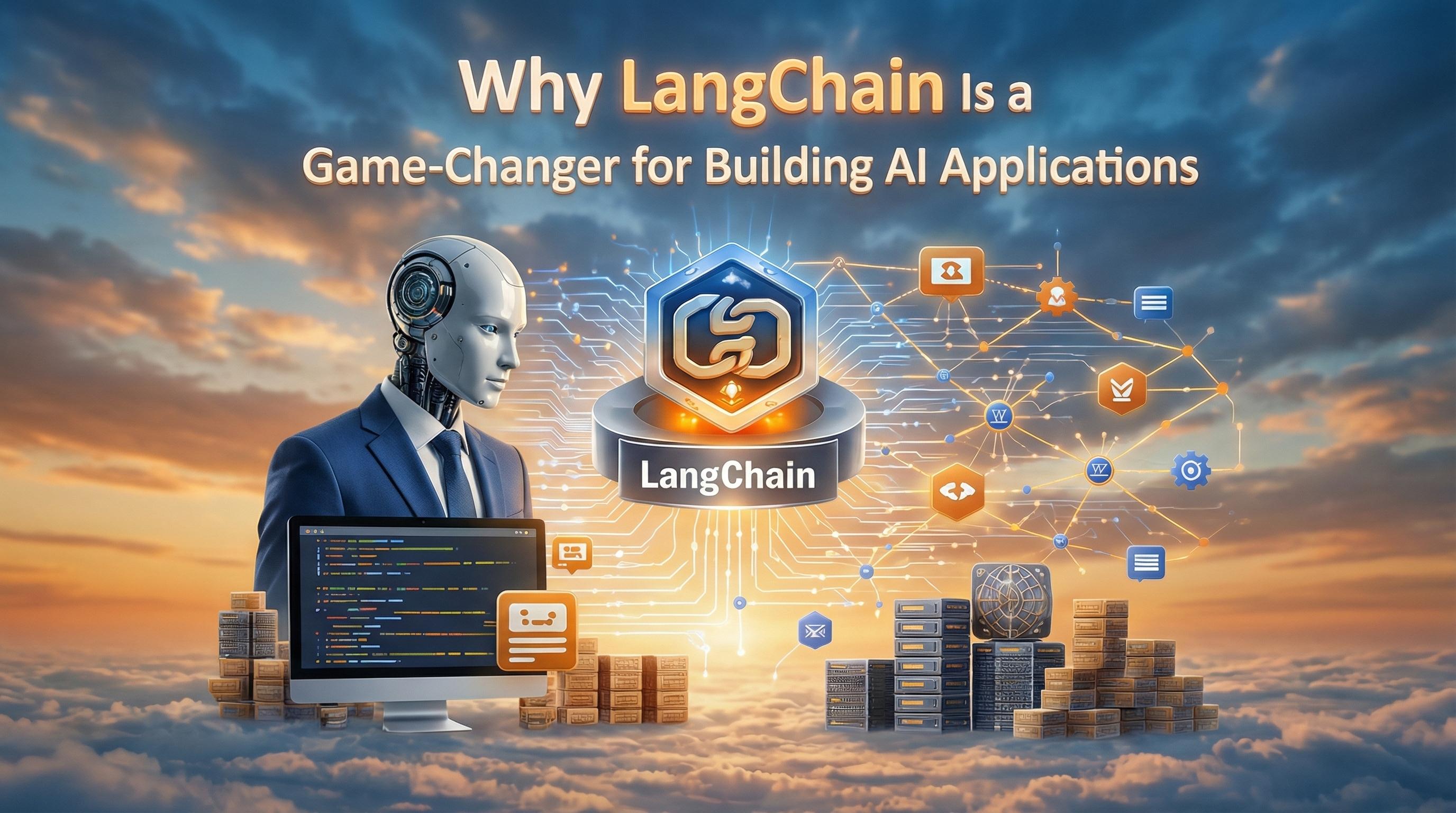
As organizations start turning AI ideas into real products, they quickly realize that the biggest challenge isn’t the model—it’s managing everything around it. What starts as a simple prompt-response interaction often evolves into something far more sophisticated. Applications begin to require multi-step reasoning, integration with external tools, memory handling, and access to dynamic data sources. Without the right structure, these systems can quickly become difficult to manage. This is exactly where LangChain proves its value.
LangChain helps bring order to this growing complexity. Instead of forcing developers to build every component from scratch, it provides a structured way to design AI workflows. This allows teams to focus less on wiring things together and more on solving actual business problems. For organizations looking to scale their AI capabilities, this shift is not just helpful—it is essential.
Faster Development with Reusable Components
One of the biggest advantages of LangChain is the speed it brings to development. Building AI systems manually requires handling prompts, managing API calls, structuring outputs, and integrating different services. This process can be time-consuming and repetitive. LangChain simplifies this by offering reusable building blocks such as prompt templates, chains, and agents. These components reduce boilerplate code and make it easier to move from idea to implementation much faster.
This speed is particularly valuable for teams that need to iterate quickly. Whether it’s a startup testing a new idea or a product team refining a feature, the ability to prototype rapidly can make a significant difference. LangChain enables developers to experiment freely without getting slowed down by infrastructure challenges, allowing them to focus on delivering value.
Simplifying Complex AI Workflows
Beyond speed, LangChain excels at simplifying complex workflows. Modern AI applications often involve multiple steps—retrieving data, processing it, applying reasoning, and generating a response. Managing these steps without a clear structure can quickly become chaotic. LangChain introduces a systematic way to design these workflows by breaking them into smaller, manageable components and linking them together.
This structured approach not only makes systems easier to build but also easier to understand and maintain. When workflows are clearly defined, debugging becomes simpler and extending the system becomes more straightforward. For businesses, this translates into more reliable applications and lower long-term maintenance costs.
Enabling Retrieval-Augmented Generation (RAG)
Another area where LangChain stands out is its support for Retrieval-Augmented Generation, commonly known as RAG. Many real-world AI applications require access to external data such as documents, databases, or internal knowledge bases. Relying solely on a model’s pre-trained knowledge is often not enough. LangChain makes it easier to build systems that can retrieve relevant information in real time and use it to generate accurate, context-aware responses.
This capability is especially useful for applications like customer support systems, knowledge assistants, and document analysis tools. By enabling AI to work with up-to-date and domain-specific information, LangChain helps improve both accuracy and trust in the system’s responses.
Seamless Integration with Tools and APIs
Integration is another area where LangChain provides significant benefits. AI systems rarely operate in isolation—they often need to interact with APIs, databases, and other tools. Managing these integrations manually can be complex and time-consuming. LangChain simplifies this process by allowing developers to connect tools directly into AI workflows. With the help of agents, applications can even decide when to use a tool, fetch data, or perform an action.
This transforms AI from a passive system into something much more dynamic and capable. Instead of just generating responses, it can actively participate in workflows, automate tasks, and interact with other systems. For businesses, this opens up new possibilities for automation and efficiency.
Building Context-Aware Applications with Memory
Another important feature of LangChain is its ability to handle memory. In applications like chatbots and virtual assistants, maintaining context across interactions is crucial. Without memory, conversations feel disconnected and repetitive. LangChain provides built-in mechanisms to store and retrieve conversation history, enabling more natural and meaningful interactions.
This leads to a better user experience, as the system can remember previous inputs and respond in a more context-aware manner. For businesses, this means building AI applications that feel more intelligent and personalized, which can significantly improve user engagement and satisfaction.
Scalability and Flexibility for Growth
As applications grow, scalability becomes a major concern. What works for a prototype may not work in production. LangChain is designed with this in mind, offering a modular architecture that allows systems to evolve over time. Developers can update individual components, switch tools, or refine workflows without rebuilding everything from scratch.
This flexibility ensures that AI systems can adapt to changing requirements without becoming overly complex or difficult to manage. It also reduces the risk of hitting limitations as the application grows, making LangChain a strong choice for long-term development.
Reducing Engineering Effort
Building AI systems from scratch, while offering full control, often requires significant engineering effort. Teams need to solve common problems like prompt management, data retrieval, and workflow orchestration on their own. This not only takes time but also increases the risk of errors and inefficiencies. LangChain reduces this burden by providing proven solutions for these challenges, allowing teams to build more confidently and efficiently.
Encouraging Faster Experimentation
Ultimately, LangChain enables faster experimentation as well. In the early stages of development, teams need to test ideas, iterate quickly, and refine their approach. LangChain lowers the barrier to experimentation by making it easy to build and modify workflows. This encourages innovation and helps teams discover what works best for their specific use case.
Final Thoughts
For most businesses, the real decision isn’t about choosing LangChain or building everything from scratch. It’s about identifying where structured frameworks actually add value and where a simpler approach is more effective.One common mistake teams make is defaulting too quickly—either adopting frameworks because they’re popular or avoiding them entirely to maintain control. Over time, both can create challenges, whether it’s unnecessary complexity or wasted effort rebuilding standard solutions. Getting this balance right early can save a significant amount of time, cost, and engineering effort as your AI systems grow.
At Stellarmind.ai, this is one of the first discussions we have with every client. We focus on understanding your use case, the level of complexity involved, and where AI can truly create impact—before recommending any approach. Sometimes that means leveraging LangChain to accelerate development, and other times it means building a more tailored solution from the ground up. Either way, the goal is to choose what fits best, not just what’s trending.
If you’re currently building AI applications and evaluating how to structure them, it’s worth taking the time to think this through carefully. The right decision early on can make everything that follows significantly smoother.