The AI ecosystem has exploded with agents that can browse the web, write code, and manage workflows. But making these agents interoperable and giving them reliable access to external tools requires standardization. That's where MCP and Agent Protocol come in.
The Problem They Solve
Before these protocols existed, every agent framework reinvented the wheel. Connecting an LLM to a database, calendar, or API required custom glue code brittle, non-reusable, and framework-specific. Scale that across dozens of tools and multiple agent systems, and you have a serious integration problem.
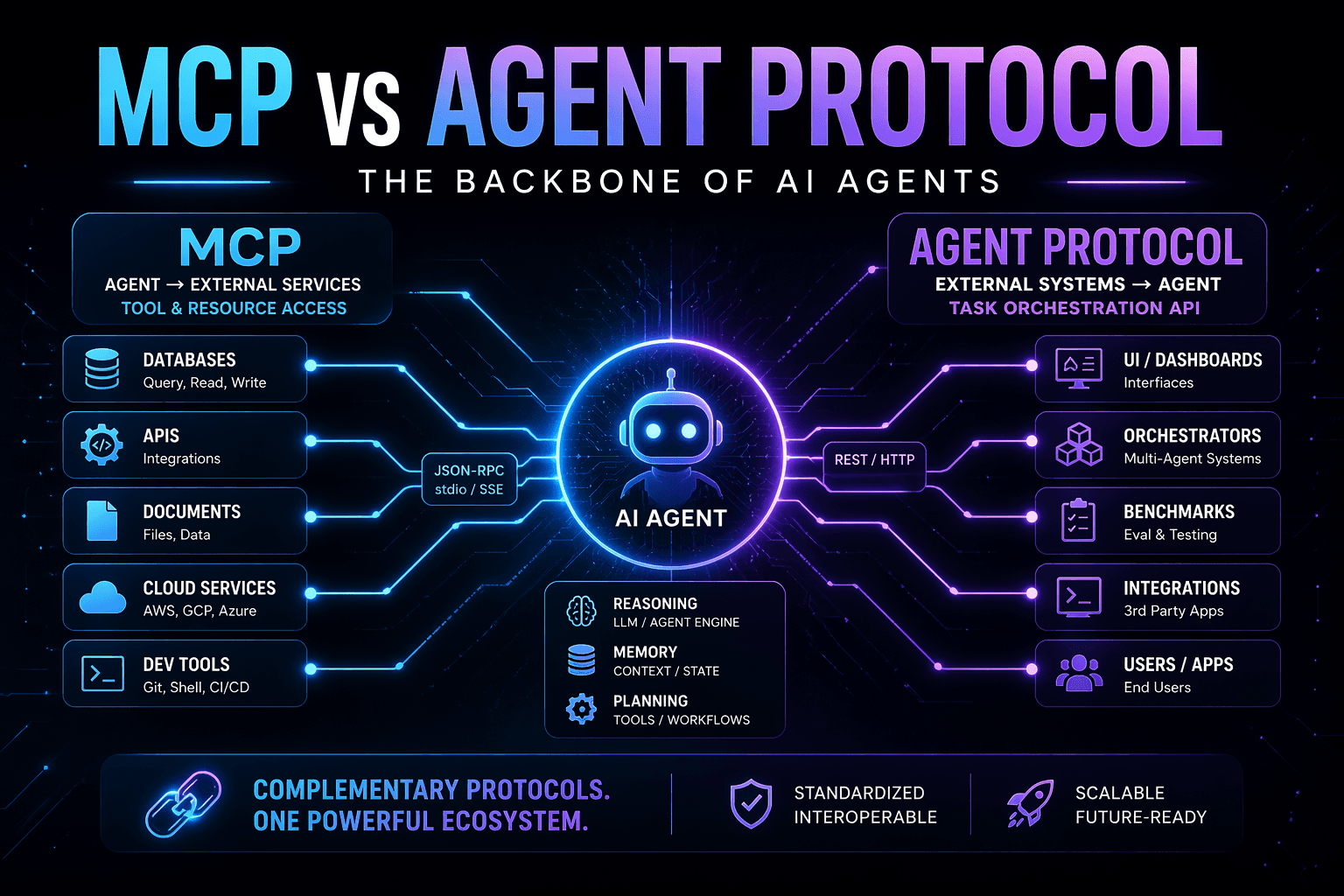
Two complementary open standards have emerged to address this from different angles: Model Context Protocol (MCP) handles how agents reach out to tools and data, while Agent Protocol defines how external systems talk to agents. Together, they form the connective tissue of modern AI agent infrastructure.
Model Context Protocol (MCP)
MCP, released by Anthropic in late 2024, is a client-server protocol that standardizes how language models connect to external tools, data sources, and services. The core insight is simple: instead of each LLM needing bespoke integrations for each tool, define a universal interface that any model can speak.
Architecture overview
MCP separates the ecosystem into three roles:
- Host - the LLM application (e.g., Claude Desktop, a custom agent)
- Client - the protocol layer running inside the host
- Server - a lightweight process exposing tools, resources, or prompt templates
Communication is via JSON-RPC 2.0, over either stdio (for local servers) or HTTP with Server-Sent Events (for remote servers). A server advertises its capabilities once on connection; the host model can then invoke them dynamically during inference.
What MCP servers expose
An MCP server can surface three types of primitives:
- Tools - callable functions (e.g., create_calendar_event, run_sql_query)
- Resources - file-like data the model can read (documents, database rows)
- Prompts - reusable prompt templates for common tasks
A well-designed MCP server is thin by design. It exposes a clean interface over an external capability it is not responsible for orchestrating agents or managing state. That separation of concerns is intentional.
A minimal server in practice
// Registering a tool on an MCP server (TypeScript SDK) server.tool( "get_weather", { location: z.string() }, async ({ location }) => { const data = await fetchWeatherAPI(location); return { content: [{ type: "text", text: JSON.stringify(data) }] }; } );
The host model receives the tool definition in its context, decides when to call it, and the MCP layer handles the round-trip transparently.
Agent Protocol
Agent Protocol, maintained by the AI Engineer Foundation, solves a different problem: it defines how you talk to an agent, not how the agent talks to its tools. It is a minimal REST API specification that any agent framework can implement, enabling benchmarks, UIs, and orchestrators to work with any agent without knowing its internals.
Core endpoints
The contract is deliberately minimal. The spec does not mandate how the agent reasons, which model it uses, or how it manages memory. It only specifies the external interface making it easy for any framework to adopt without architectural constraints.
Why this matters for benchmarking
One of the most practical wins is evaluation. Projects like AutoGPT Benchmarks and AgentEval can send standardized tasks to any Agent Protocol-compliant agent and collect results comparably without writing framework-specific harnesses. That is a significant step toward reproducible agent evaluation.
How They Differ and Where They Overlap
MCP
- Agent → External services
- Tool / resource access
- JSON-RPC over stdio / SSE
- By Anthropic (open spec)
- Integration layer
Agent Protocol
- External systems → Agent
- Task orchestration API
- REST / HTTP
- AI Engineer Foundation
- Interface / API layer
They are complementary rather than competing. A production agent might expose itself via Agent Protocol (so an orchestrator can spin it up and assign tasks) while internally using MCP servers (to give it access to databases, APIs, and file systems). The two protocols operate at different layers of the stack.
Think of it as: Agent Protocol defines the agent's front door. MCP defines all the back doors the agent can open to reach external systems.
Practical Implications for Developers
If you are building tooling or services that agents should be able to use, implement an MCP server. The ecosystem is growing rapidly there are already community-maintained servers for databases, cloud providers, dev tools, and productivity apps. Anthropic publishes an official SDK for TypeScript and Python.
If you are building an agent framework or want your agent to be testable and interoperable, implement Agent Protocol on your HTTP layer. It is a thin addition that pays dividends in composability your agent becomes a generic building block rather than a closed system.
For teams building complex multi-agent systems, the two protocols compose naturally: a supervisor agent dispatches sub-agents via Agent Protocol, while each sub-agent uses MCP to access the tools it needs. This architecture scales cleanly and keeps each layer's concerns clearly separated.
The Road Ahead
MCP has seen rapid adoption since its release Claude Desktop, Cursor, Zed, and a growing list of IDEs and agent frameworks support it natively. The spec continues to evolve, with ongoing work on authentication, multi-server composition, and streaming responses.
Agent Protocol is earlier in its adoption curve, but frameworks like AutoGPT, LangChain, and BabyAGI have already implemented it. As the need for agent interoperability grows particularly in enterprise environments running heterogeneous agent stacks its importance will only increase.
Both protocols reflect a broader maturation of the AI agent ecosystem: moving from bespoke, siloed implementations toward principled, composable infrastructure. For developers building in this space, understanding both is quickly becoming foundational knowledge.