What is a Small Language Model?
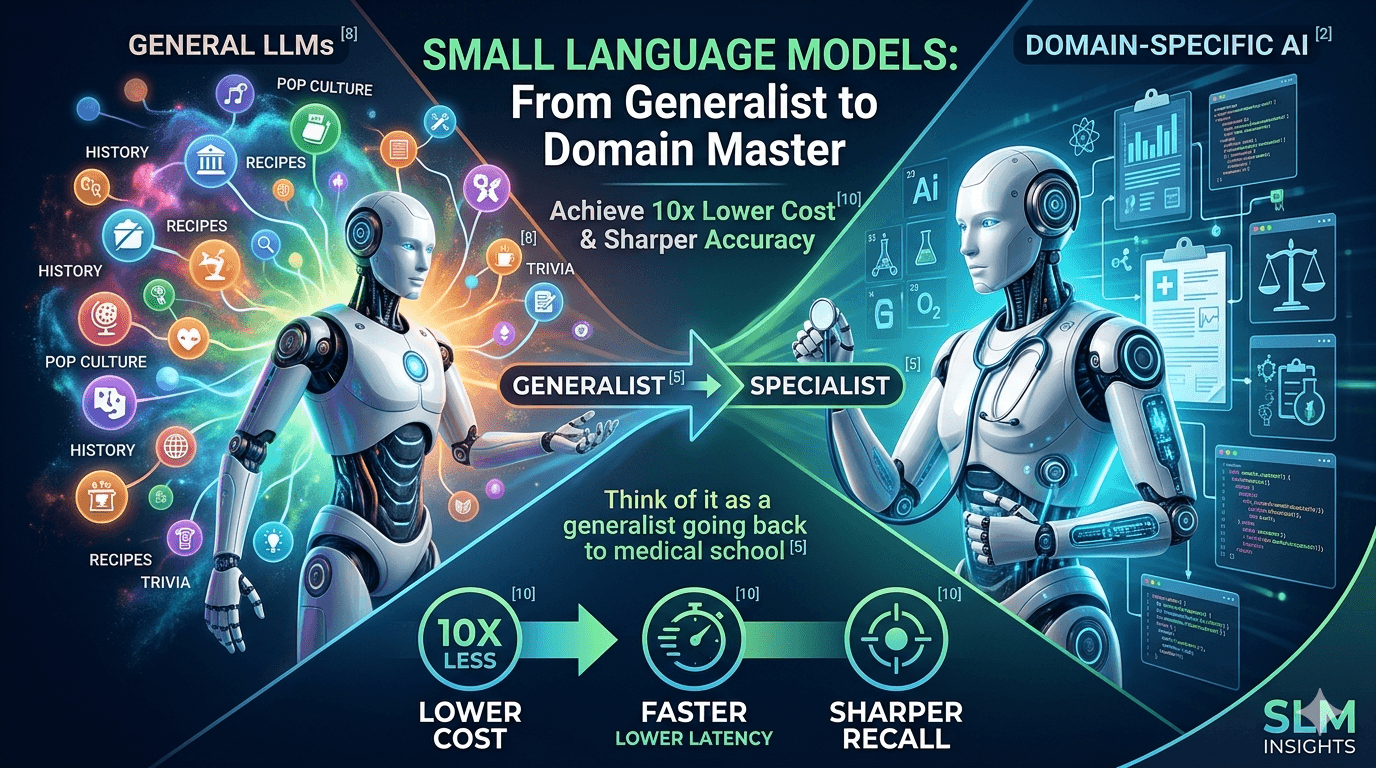
A Small Language Model (SLM) is a transformer-based model with 1B–10B parameters, pre-trained on general data and then fine-tuned on a specific domain. Think of it as a generalist going back to medical school — they lose nothing universal, but gain deep domain mastery on top.
Why SLMs Beat General LLMs on Specific Tasks
General LLMs spread their capacity across all of human knowledge. By contrast, a 3B parameter model trained exclusively on medical data encodes deeper medical reasoning than a 70B general model — because every weight is domain-relevant. The result: less noise, sharper recall, lower latency, and approximately 10x lower cost per token.
The Domain SLM Pipeline
A typical domain SLM is built through the following sequential stages:
What Domains Benefit Most?
Recommended Starter Models
Limitations & Mitigations
Understanding SLM limitations is essential before production deployment. Each limitation below has practical mitigations:
Out-of-Domain Failure
- A medical SLM asked a legal question will hallucinate confidently. Domain fine-tuning creates specialisation but removes breadth.
- Mitigation: Add a router/classifier that detects off-domain queries and routes them to a general model, or returns 'I don't know.'
Hallucination Is Still Present
- SLMs hallucinate less than general LLMs within their domain — but they still invent facts.
- Mitigation: Do not deploy without a retrieval layer (RAG) or factual verification step in high-stakes domains like healthcare or law.
Small Context Window
- Most SLMs have 4K–8K token contexts vs. 128K+ for large models. Long documents require chunking and summarisation before being passed to the model, adding latency and complexity.
Multi-Step Reasoning Gaps
- Complex chain-of-thought tasks — multi-hop reasoning, math proofs — are weaker in SLMs. Phi-3.5 is notably better here than others.
- Mitigation: Use chain-of-thought prompting or break tasks into sub-questions.
Fine-Tuning Needs Clean, Curated Data
- Data quality is the single biggest factor in fine-tune performance. 500 high-quality domain Q&A pairs beat 50,000 noisy ones.
- Note: Budget 70% of effort on data curation — it is the most impactful step.
Catastrophic Forgetting
- Aggressive fine-tuning can overwrite general capabilities such as instruction following and output formatting.
- Mitigation: Use LoRA to keep base weights frozen. If doing full fine-tuning, apply regularisation or mix domain data with general instruction data.
SUMMARY
Getting Started with Small Language Models
If you are new to SLMs, the following five-step practical path will take you from zero to a production-ready deployment:
Step 1 — Run a Quick Hands-On Test
Install Ollama and run lightweight models such as Llama 3.2 3B or Phi-3 Mini on your local machine. Spend a few hours testing them on your real use cases — not benchmarks. This gives you an immediate sense of speed, responsiveness, and limitations versus larger models.
Step 2 — Identify the Right Use Cases
Evaluate your current AI workloads and categorise them:
- Predictable, repetitive tasks (classification, extraction, templated responses) — strong SLM candidates
- Complex, open-ended queries — may still require a larger model
SLMs can deliver strong performance with significantly lower cost and latency for the first category.
Step 3 — Fine-Tune for Better Performance
Fine-tuning an SLM is lightweight — typically hours, not days. Using Hugging Face Transformers on Google Colab, even developers with basic Python knowledge can meaningfully improve model accuracy and relevance for their domain.
Step 4 — Deploy Locally or On-Premise
Start small — a single GPU machine or a high-performance laptop is sufficient. Monitor these key metrics:
- Latency
- Cost per query
- Output quality
Compare against your current cloud-based LLM usage. Many teams see a positive ROI within the first month due to reduced API costs and faster response times.
Step 5 — Scale with a Hybrid Architecture
Once validated, implement a routing layer:
- Send simple, repetitive queries to your SLM
- Route complex or reasoning-heavy queries to a cloud-based LLM
This hybrid setup balances cost efficiency with high-end capability — a practical and scalable approach for production systems.