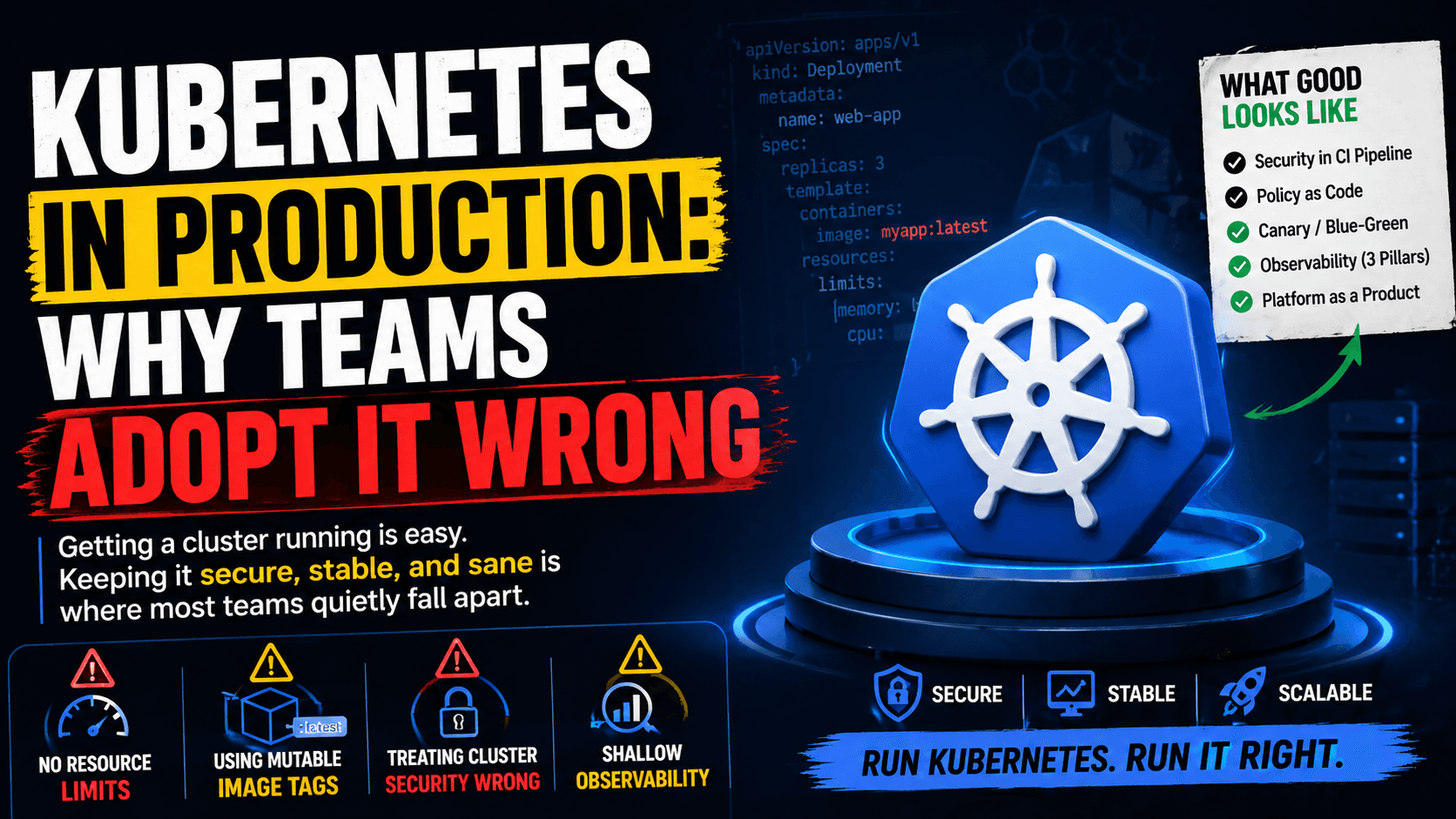
Getting a cluster running is the easy part. Keeping it secure, stable, and sane is where most teams quietly fall apart.
Every engineering team adopting Kubernetes hits the same moment. The cluster is up, deployments are running, and everything looks fine until it isn't. A service crashes in production for no obvious reason. A security scan surfaces a critical vulnerability that was shipped weeks ago. Costs balloon with no clear explanation.
This is the gap Kubernetes exposes: the difference between getting it running and actually running it well.
Why Kubernetes Is Harder Than It Looks
Kubernetes is not just a deployment tool. It is a complete shift in how infrastructure is managed from manually configured, static servers to a system that continuously reconciles what you want with what is actually running. That mental model alone takes time to internalize.
Most teams underestimate this. They get through setup, then struggle when Day 2 operations hit: debugging strange pod restarts, managing persistent storage, handling networking across services, or maintaining consistency across multiple clusters. The tooling is powerful, but it demands discipline.
The real bottleneck is rarely access to Kubernetes it's the depth of understanding required to operate it safely at scale.
The Mistakes Teams Make Most Often
Most production failures in Kubernetes environments trace back to a handful of recurring patterns.
NO RESOURCE LIMITS
Deploying without CPU and memory limits is one of the fastest ways to bring down a production node. A single runaway process can starve every other service on the same host. Define requests and limits for every workload it is not optional.
USING MUTABLE IMAGE TAGS
The: latest tag is not a version. Pulling the same tag twice can return completely different images. Use versioned tags or SHA256 image digests to ensure what you tested is exactly what gets deployed.
TREATING CLUSTER SECURITY AS IMAGE SECURITY
Locking down your container images is necessary but not sufficient. Default Kubernetes networking is flat any pod can talk to any other pod. Without Network Policies enforcing Zero Trust segmentation, a compromised workload can move laterally across your entire cluster. Secrets stored as base64-encoded Kubernetes objects are just as exposed. Integrate a proper secrets manager and enforce Pod Security Admission at the namespace level.
SHALLOW OBSERVABILITY
Knowing that a service is "up" tells you almost nothing. Real observability means metrics to catch resource spikes, structured logs to understand why something failed, and distributed tracing to follow a request across every service it touches. Without all three, root cause analysis in a microservices environment becomes guesswork.
What Good Looks Like
Teams that operate Kubernetes well share a few common practices. Security is embedded into the CI pipeline image scanning with tools like Trivy runs automatically, and builds fail if critical vulnerabilities are found. Policy-as-Code tools like Kyverno or OPA Gatekeeper enforce resource limits, security contexts, and labeling standards before anything reaches the cluster. Rollouts use Canary or Blue/Green strategies so that a bad deployment never takes down your entire production environment at once.
Most importantly, these teams treat their platform as a product. They build internal tooling that gives developers safe defaults and guardrails, so the right way to deploy is also the easiest way.
Kubernetes rewards teams that treat it with architectural seriousness. The clusters that run reliably are not the ones with the most complex configurations they are the ones where every decision, from resource limits to image signing, was made deliberately.
If your team is navigating adoption challenges or trying to close gaps in your production setup, that is exactly the kind of problem worth getting right early.