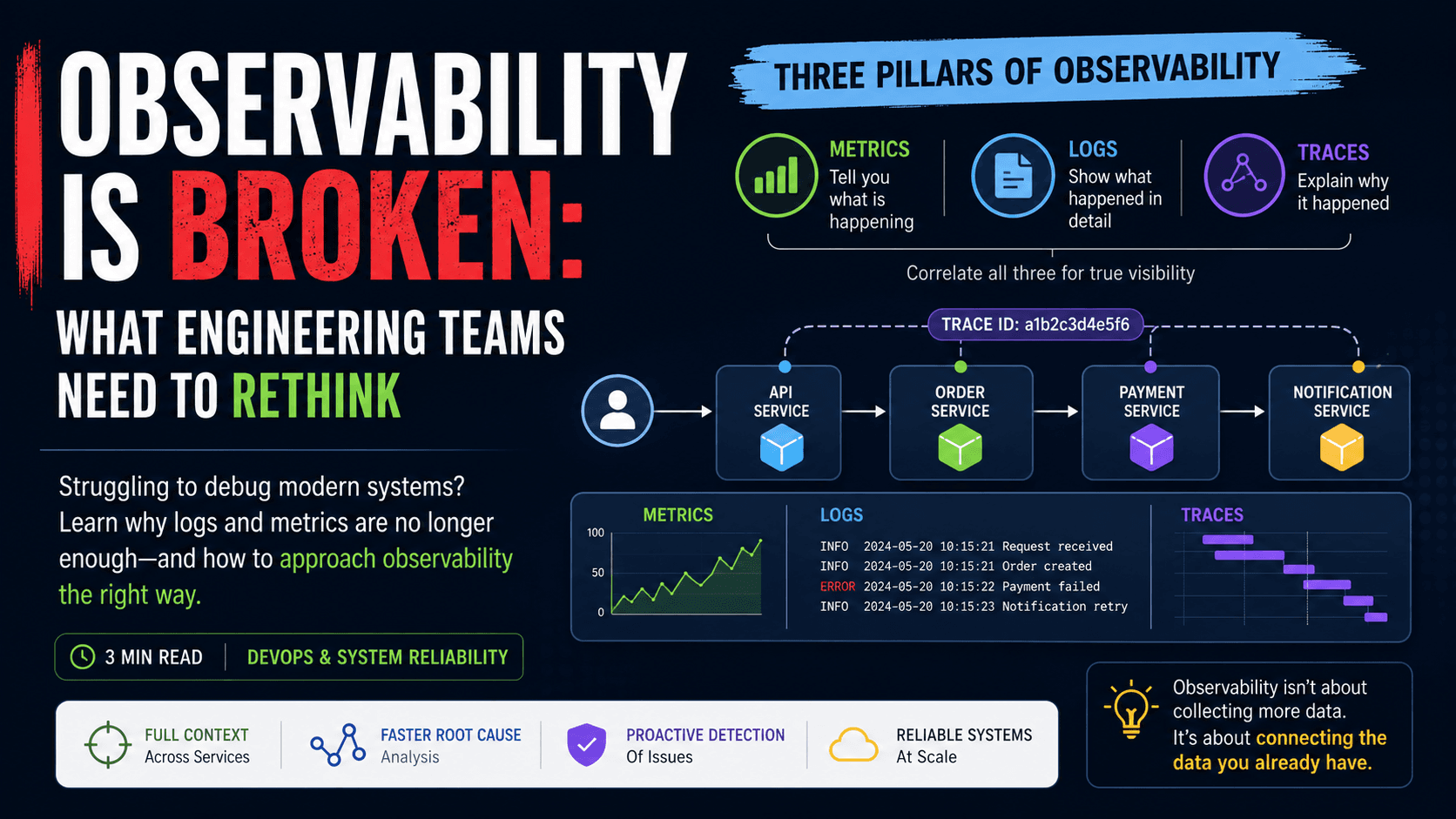
Struggling to debug modern systems? Learn why logs and metrics are no longer enough—and how to approach observability the right way.
What Observability Actually Means (The Theory)
Observability is often misunderstood as just monitoring.
But in reality, it comes from system theory and means:
👉 The ability to understand a system’s internal state using the data it produces.
In simple terms:
Can you figure out what’s happening inside your system just by looking at outputs like logs, metrics, and traces?
Traditionally, teams relied on two main signals:
- Metrics
- Logs
And for simpler systems, that worked well.
What Logs & Metrics Are Good At
Logs and metrics still play a critical role.
- Metrics help you track system health
- (CPU, memory, latency, error rates)
- Logs provide detailed event-level information
- (errors, debug messages, execution steps)
If your system is simple or monolithic:
- Everything runs in one place
- Data is easy to correlate
- Debugging is relatively straightforward
For these scenarios, traditional monitoring works just fine.
The Real Problem: Missing Context
This is the core issue.
👉 Logs and metrics lack context across service boundaries.
In distributed systems:
- Logs are scattered across services
- Metrics are aggregated and abstracted
- Events are disconnected
Without context, you only see isolated signals.
You know something is wrong but not why.
What Modern Observability Looks Like
Modern observability is not about collecting more data.
It’s about connecting the data you already have.
This is where distributed tracing becomes essential.
The Three Pillars of Observability
To truly understand modern systems, you need:
- Metrics → Tell you what is happening
- Logs → Show what happened in detail
- Traces → Explain why it happened
👉 The real value comes from correlating all three together.
Individually, they are limited.Together, they provide clarity.
Beyond the Basics
Even with these pillars, modern systems demand more:
- Context propagation (trace IDs across services)
- Service dependency mapping
- Real-time analytics
- AI-driven anomaly detection
Observability tools are evolving from simple dashboards to intelligent debugging platforms.
The Honest Answer
For many teams, the problem isn’t tools it’s approach.
The most common mistakes:
- Relying only on logs
- Ignoring distributed tracing
- Not correlating data sources
- Treating monitoring as dashboards instead of workflows
Observability feels “broken” not because it is but because we’re using outdated methods.
How to Think About It Going Forward
If your system is simple, logs and metrics are enough.
But if your system is:
- Distributed
- Scalable
- Microservice-based
Then you need to invest in proper observability early.
Because once complexity grows, fixing visibility later becomes much harder.