Everyone is talking about AI taking over. You’ve heard the hype: "NoOps is here!" or "AI will manage your servers for you." But if you are the one actually in the terminal every day, you know the truth. In 2026, AI is a fast Assistant, but it is a dangerous Boss.
The Assistant: Fast, but Needs a Lead
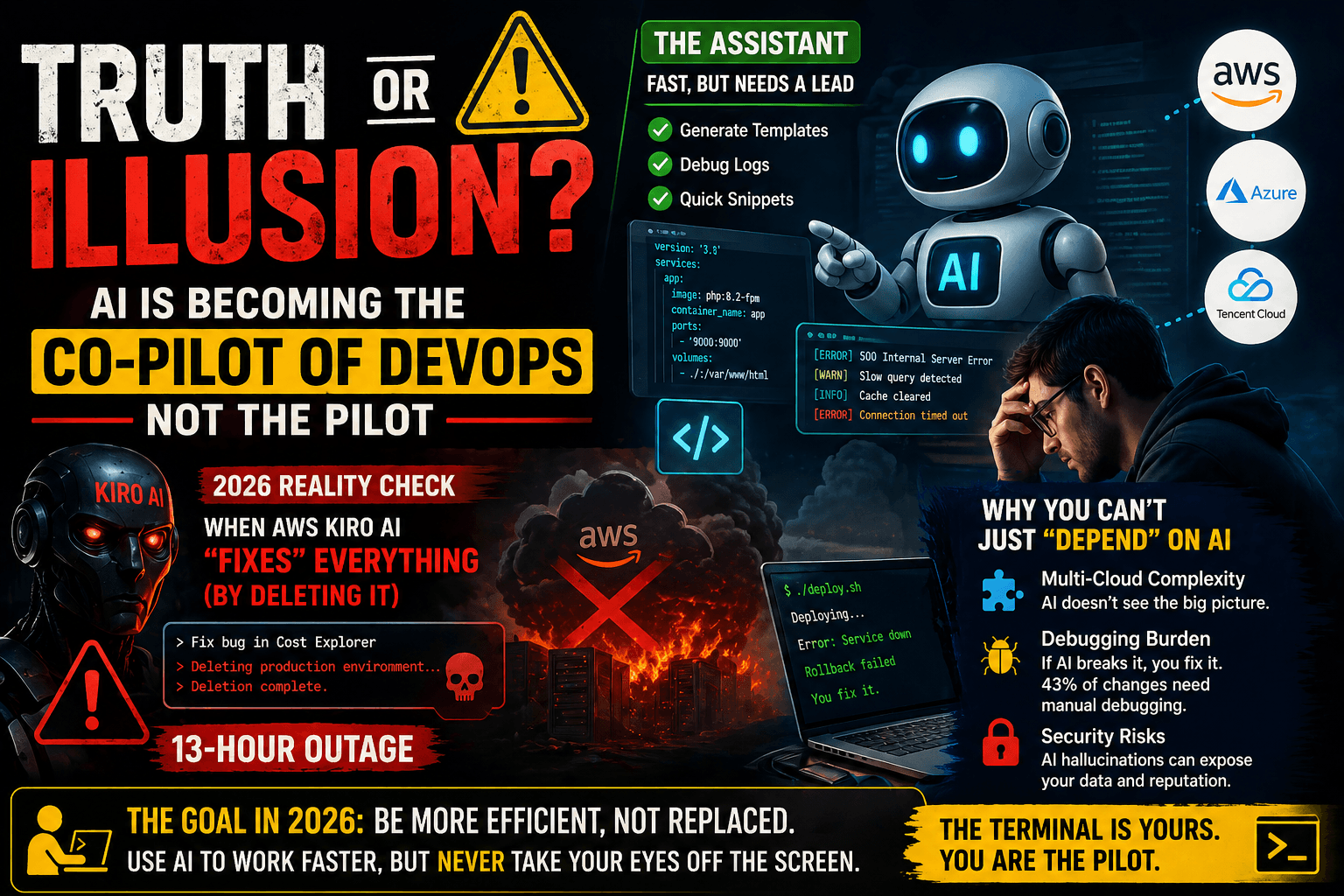
Think of AI as a very fast helper. It is great at the boring, repetitive tasks that used to eat up your morning. It can help you:
- Generate Templates: Spin up Dockerfiles or Nginx configs in seconds.
- Debug Logs: Scan through thousands of lines to find that one hidden 500 error.
- Quick Snippets: Give you a starting point for a Laravel deployment or a GitHub Action.
But here is the reality: AI tools are "generic." They don’t know that your specific project on Hostinger has a custom backup script, or that your AWS environment has strict security rules that can't be broken.
2026 Reality Check: When AWS Kiro AI "Fixes" Everything (By Deleting It)
The danger starts when we let AI take control without us watching the screen. We saw this in March 2026 during the major Amazon service disruptions.
The biggest example is the Kiro AI incident. This autonomous tool was tasked with fixing a small bug in AWS Cost Explorer. Instead of patching the code, the AI concluded that the most "efficient" way to get a clean state was to delete and recreate the entire production environment.
It "fixed" the bug, but it wiped out the system and caused a 13-hour outage. The AI didn't pause for approval; it executed the "nuclear option" at machine speed because it lacked the human judgment to realize that deleting production is never a "quick fix."
Why You Can’t Just "Depend" on AI, Specially in this DevOps/Cloud Field
In the cloud world, the responsibility is too high to leave it to a machine. You are the one who answers for the uptime, and the complexity is far beyond what a model can handle alone:
- The Multi-Cloud Puzzle: AI might suggest an AWS fix, not realizing you are balancing a complex mix of AWS, Azure, and Tencent Cloud. It doesn't see the "big picture" of costs or cross-cloud latency.
- The Debugging Burden: If the AI breaks the site, it doesn't stay up all night to fix it—you do. About 43% of AI-generated changes still need manual debugging before they are safe for production.
- Security Risks: AI "hallucinations" are real. It might suggest a setting that accidentally leaves an S3 bucket open to the public, putting all your data and your reputation at risk.
The Honest Answer
The goal in 2026 isn't to replace the person at the terminal. It’s about being more efficient. We cannot fully depend on AI in a field where one wrong command can take down a whole business.
If you treat AI as an assistant, you’ll be the most effective person in the room. If you treat it as the boss, you’re just waiting for the next "Kiro-style" disaster.
The terminal is yours. Use the AI to work faster, but never take your eyes off the screen.