Confused between serverless and containers? Learn how to choose based on scalability, control, and real-world architecture needs.
Every team building in the cloud eventually reaches the same decision point:
Do you go with serverless and let the cloud provider handle infrastructure for you? Or do you use containers for greater control and flexibility?
It sounds like a technical choice. In reality, it is often a business decision too, affecting cost, scalability, operational overhead, and how fast you can move.
Here is how to think through it.
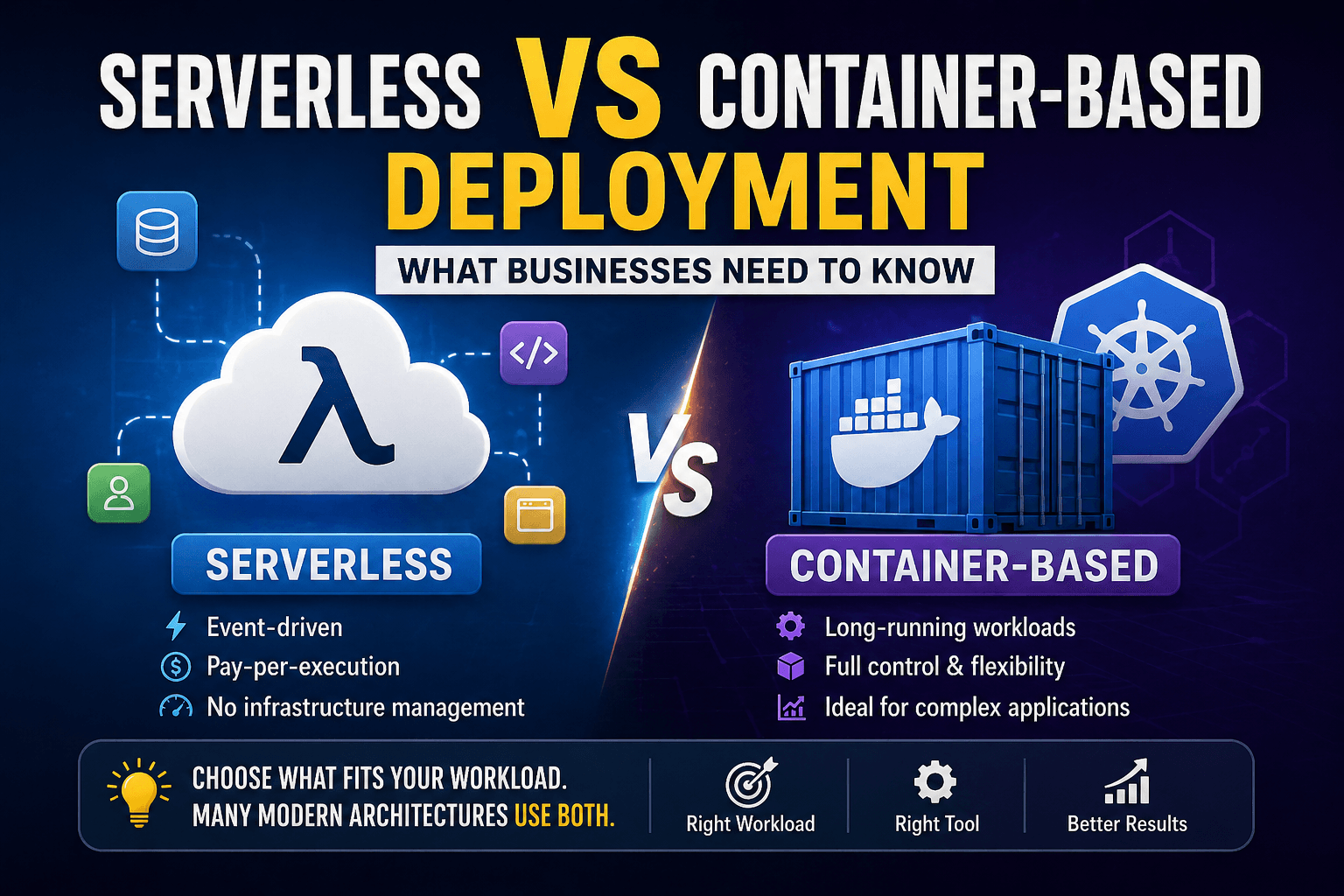
What Serverless Is Good At
Serverless works well when your workloads are event-driven, lightweight, and unpredictable.
With platforms like Amazon Web Services Lambda, Microsoft Azure Functions, and Google Cloud Functions, you write code while the provider handles servers, scaling, and maintenance.
That makes serverless ideal for:
- Processing uploads or triggers
- Running background automation
- APIs with variable traffic
- Short-lived workloads
- Rapid MVP development
You only pay when code runs, which can make it highly cost-effective for sporadic workloads.
If you need to move fast without managing infrastructure, serverless is often the right starting point.
Where Serverless Starts to Break Down
The trade-offs appear when workloads become persistent or more complex.
Cold starts can introduce latency. Execution limits can restrict long-running tasks. And runtime customization is often limited.
That becomes a problem for systems that need:
- Continuous processing
- Stateful services
- Heavy compute workloads
- Deep control over the runtime environment
At that point, serverless can start feeling more restrictive than convenient.
What Containers Are Good At
Containers solve a different problem.
Using tools like Docker and Kubernetes, applications run in portable, isolated environments with full control over dependencies and runtime behavior.
This makes them ideal for:
- Microservices architectures
- Long-running applications
- Complex backend systems
- High-performance workloads
- Stateful services
A banking platform, for example, may run authentication, transaction processing, and notifications as separate containerized services managed through Kubernetes.
That level of control is difficult to replicate with pure serverless.
Where Containers Start to Break Down
Containers bring flexibility, but they also bring responsibility.
You have to manage orchestration, monitoring, scaling, and infrastructure operations.
And unlike pay-per-execution models, costs continue even when services sit idle.
For simple event-driven tasks, containers can be more overhead than they are worth.
How to Know Which One You Need
Ask yourself three questions.
Is my workload event-driven or persistent?
If it runs only when triggered, serverless may be ideal. If it runs continuously, containers are usually the better fit.
Do I need control or convenience?
If speed and simplicity matter most, choose serverless. If runtime control and flexibility matter, choose containers.
Am I solving for today or for scale?
Serverless works well to move quickly. But if this becomes core infrastructure, containers may scale better long term.
Real-World Architecture Often Uses Both
The honest answer is that most modern architectures use both.
An e-commerce platform might use serverless for image processing and notifications, while core services like payment, inventory, and order management run in containers.
A CI/CD workflow might use serverless to trigger builds, while Jenkins runs inside containers.
A streaming platform may rely heavily on containers for encoding and delivery while using serverless for event-based automation.
This hybrid model is increasingly the norm.
The Real Decision
Serverless and containers are not competing answers to the same problem. They solve different problems.
Use serverless when abstraction reduces operational burden.
Use containers when control is essential.
And use both when the architecture demands it.
The biggest mistake teams make is choosing one model as a default instead of choosing based on workload.
Get that decision right early, and you save time, reduce cost, and avoid architectural pain later.