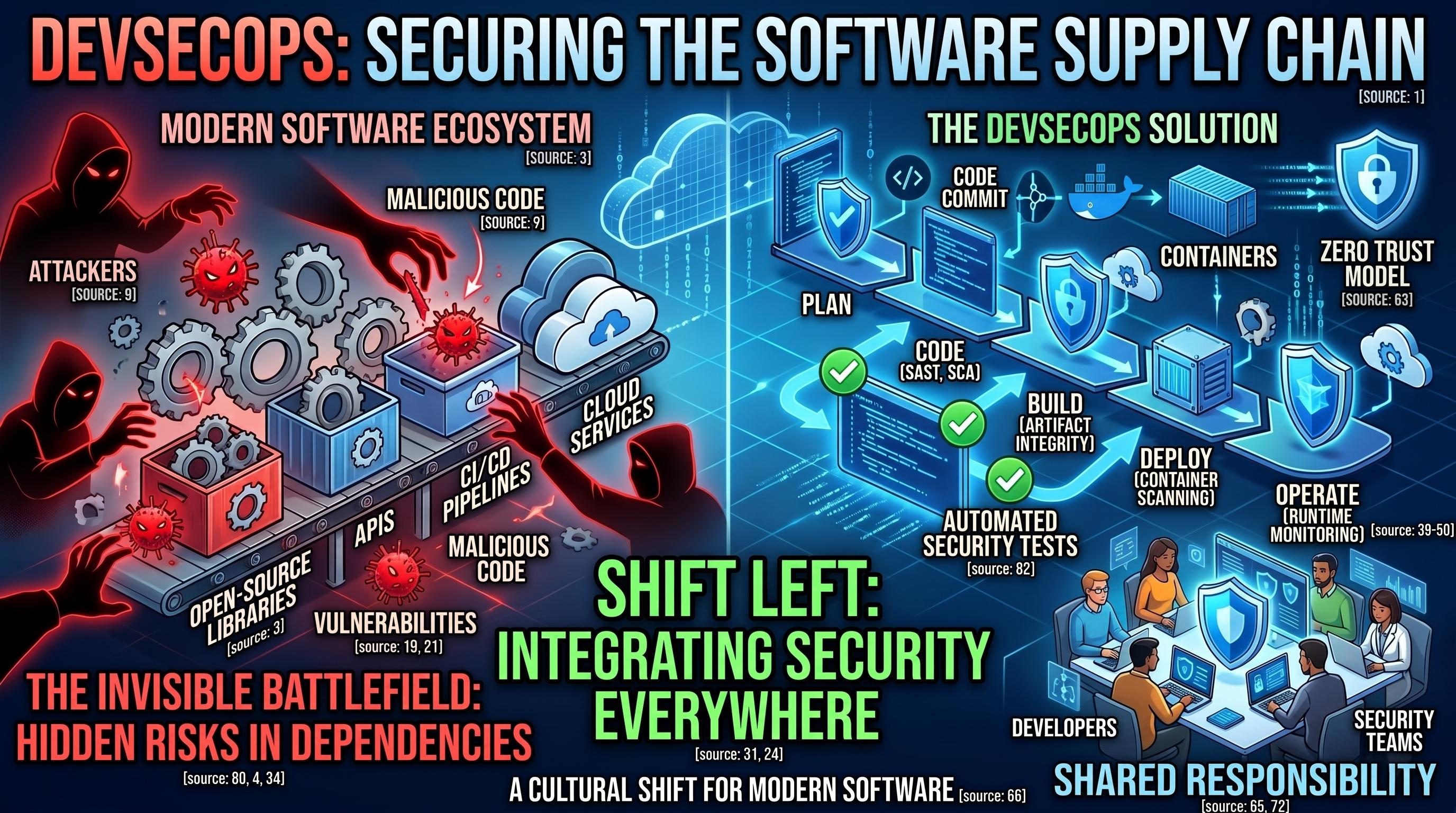
Software development has evolved dramatically. Applications today are no longer written entirely from scratch they are assembled ecosystems built on open-source libraries, APIs, containers, and cloud-native services.
This modular approach accelerates innovation. But it also introduces a hidden risk:
You don’t just ship your code you ship everything your code depends on.
And that’s exactly where attackers are focusing.
🚨 The New Battlefield: Software Supply Chain
The software supply chain includes every component, tool, and process involved in delivering software from code to deployment.
Attackers no longer need to break your system directly. Instead, they target:
- Third-party dependencies
- CI/CD pipelines
- Container images
- Build tools and repositories
This shift makes attacks more scalable, stealthy, and impactful.
🔓 Real Problem: Trust is Being Exploited
Developers trust tools. Teams trust dependencies. Systems trust automation.
Attackers exploit this trust.
Instead of hacking production servers, they:
- Inject malicious code into packages
- Compromise build pipelines
- Embed backdoors in dependencies
By the time the application is deployed, the damage is already inside.
🔐 What is DevSecOps?
DevSecOps is the practice of integrating security into every phase of the DevOps lifecycle.
It transforms security from a final checkpoint into a continuous responsibility.
Old Thinking:
“We’ll test security before release.”
Modern Thinking:
“Security is built into every commit, build, and deployment.”
⚙️ Why DevSecOps Matters More Than Ever
⚡ 1. Speed Without Security = Faster Breaches
Rapid releases mean vulnerabilities can spread just as quickly if security is ignored.
📦 2. Dependency Explosion
Modern apps rely heavily on external components increasing the attack surface dramatically.
💸 3. Cost of Ignoring Security
Fixing issues:
- During development → minimal cost
- After release → exponentially higher
🔄 DevSecOps Across the Pipeline
🧩 Code Stage
- Secure coding practices
- Static Application Security Testing (SAST)
- Peer reviews with security focus
📦 Dependency Management
- Software Composition Analysis (SCA)
- Continuous vulnerability monitoring
- Use trusted repositories
🏗️ Build & CI/CD
- Secure pipelines
- Secret detection (API keys, tokens)
- Artifact integrity checks
🐳 Containers & Infrastructure
- Image scanning
- Minimal base images
- Infrastructure as Code (IaC) security validation
🚀 Runtime & Deployment
- Runtime monitoring
- Threat detection systems
- Incident response automation
🛠️ Core DevSecOps
Shift Left Security → Start early, not later
Automation First → Integrate tools into CI/CD
Zero Trust Model → Verify everything
Continuous Monitoring → Security never stops
Shared Responsibility → Everyone owns security
💡 The Cultural Shift
DevSecOps isn’t just a technical upgrade it’s a mindset change.
Before:
Security is the responsibility of a separate team
Now:
Security is part of development itself
Developers, DevOps engineers, and security teams must collaborate not operate in silos.
🔮 The Future: Secure-by-Design
The future of software is secure-by-design, where security is not added it is built-in from day one.
Organizations that fail to adapt will face:
- Increasing cyberattacks
- Loss of customer trust
- Financial and reputational damage
🧠 Final Thoughts
The software supply chain has become an invisible battlefield.
- Attackers are evolving
- Systems are becoming complex
- Risks are growing silently
DevSecOps is not a toolset. It’s a survival strategy.
It’s not optional.
It’s not a trend.
It’s the foundation of modern software security.