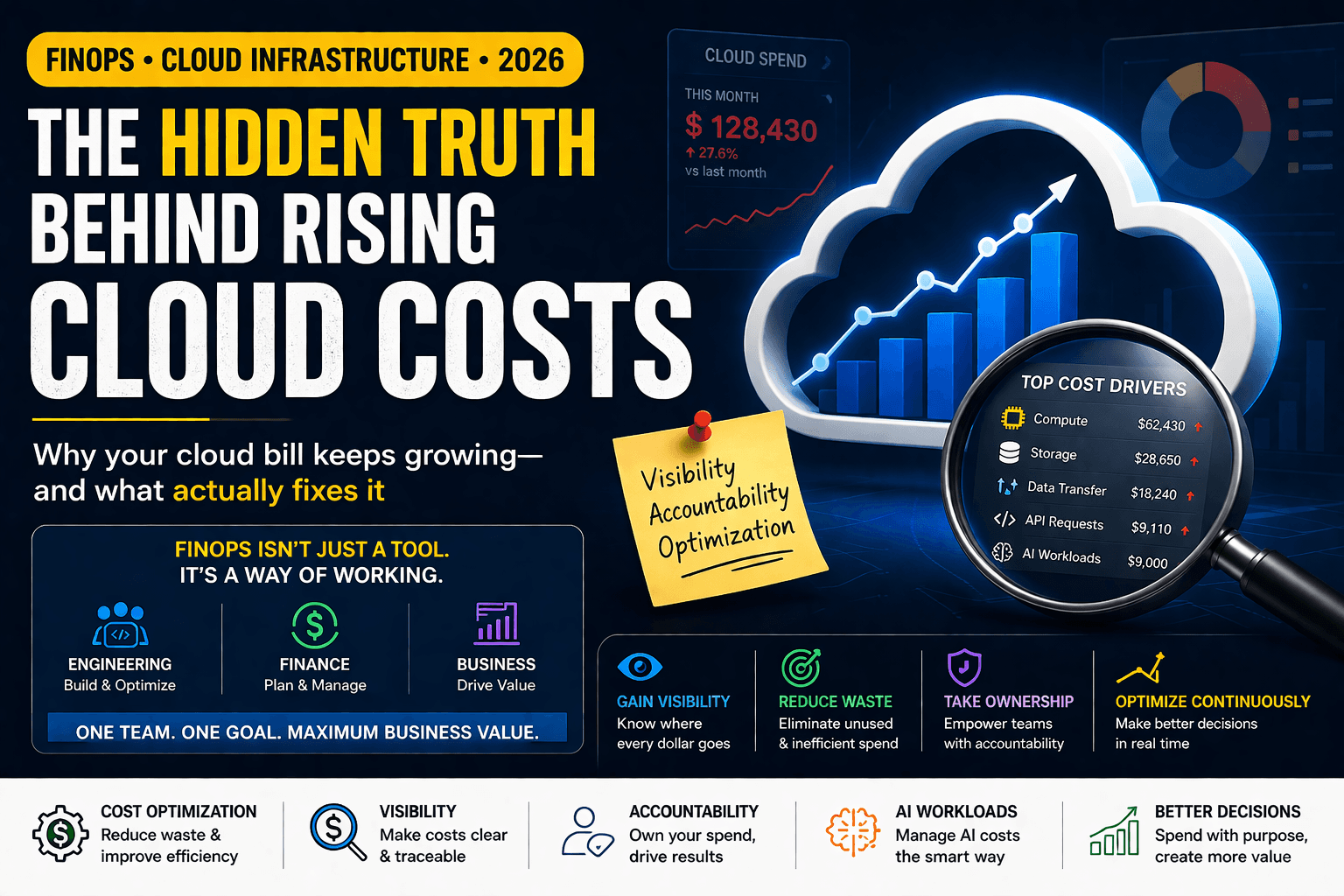
Why your cloud bill keeps growing and what actually fixes it
Cloud computing promised something simple.
Stop paying for infrastructure you don't use. Scale when needed. Reduce costs overall.
At first, it worked.
Then the bills started increasing.
For many businesses today, cloud spending is no longer predictable. What started as a flexible cost has turned into a growing expense influenced by daily technical decisions.
Most of those decisions are not tracked in real time.
That's where the real problem begins.
Why Cloud Costs Keep Rising
Cloud cost issues rarely come from one single cause. They build up over time.
The biggest issue is visibility.
Cloud platforms generate a lot of billing data, but it's often unclear. Costs are grouped together, making it difficult to identify which team or service is responsible. When no one clearly sees the problem, no one takes ownership.
There is also hidden waste.
Idle resources are no longer obvious. Waste now exists in architecture oversized systems, inefficient scaling, and unnecessary service communication.
Pricing itself is complex.
Cloud costs are not based on a single factor. They include compute, storage, data transfer, and API usage. Small technical changes can increase costs without being noticed immediately.
And behind all of this is a coordination problem.
Engineering focuses on performance. Finance focuses on budgets. Without alignment, costs continue to grow without control.
The New Cost Factor: AI Workloads
Recently, AI has added a new layer to cloud spending.
AI workloads rely heavily on high-performance resources, which are more expensive than traditional infrastructure. Many AI services also charge based on usage such as tokens or requests meaning costs increase directly with usage.
For businesses adopting AI quickly, this has created unexpected expenses.
To manage this, companies are starting to:
- Use smaller and more efficient models
- Avoid repeated API calls through caching
- Optimize usage to reduce unnecessary costs
AI is now becoming a major cost driver, not just a feature.
What FinOps Actually Means
FinOps is often misunderstood.
It is not just about tracking cloud costs or using dashboards. It is a way of working that connects three groups:
- Engineering
- Finance
- Business
Instead of working separately, these teams operate together to manage cloud spending continuously.
The goal is not to spend less at all costs. The goal is to make sure every expense is intentional and valuable.
Three core ideas define FinOps:
Cost Optimization: Reducing waste and improving efficiency.
Visibility: Making costs clear and traceable.
Accountability: Ensuring teams understand and own their spending.
What Actually Works in Practice
Effective FinOps comes down to a few consistent habits.
Clear tracking is essential.
Every resource should be linked to a team or purpose. Without this, costs remain unclear.
Regular adjustment is also important.
Many systems are set up for peak usage but never reduced. Reviewing and resizing resources helps control costs.
Real-time monitoring makes a difference.
Waiting for monthly reports is too late. Costs should be tracked continuously, just like performance.
The real question is not how much is being spent but what that spending is achieving.
Why Most Efforts Fail
Most FinOps attempts fail because they are treated as a reporting activity.
Tracking costs is not the same as controlling them. When cost management is reactive, problems are only addressed after they grow.
Another common issue is keeping engineers disconnected from cost impact. If the people building systems are not aware of cost implications, spending cannot be controlled effectively.
FinOps requires a shift in thinking.
Cost should be considered during design, not after deployment.
The bottom line: Cloud computing changed how infrastructure works and how costs behave. Costs are no longer fixed. They are influenced by daily decisions across teams. FinOps helps bring structure to this by improving visibility, accountability, and continuous optimization. Without it, cloud spending grows unpredictably. With it, costs become manageable and aligned with business goals.
As systems become more complex and AI usage increases, managing cloud cost is no longer optional.
It is a core part of building and running modern technology.