DevOps promised speed, automation, and better collaboration. And it delivered—initially. But as organizations scaled, a new issue quietly grew: tool sprawl.
Teams started adopting different CI/CD tools, monitoring systems, and infrastructure frameworks. What was meant to increase efficiency slowly turned into complexity. This is where Platform Engineering steps in—bringing structure, standardization, and a better developer experience.
What is DevOps Tool Sprawl?
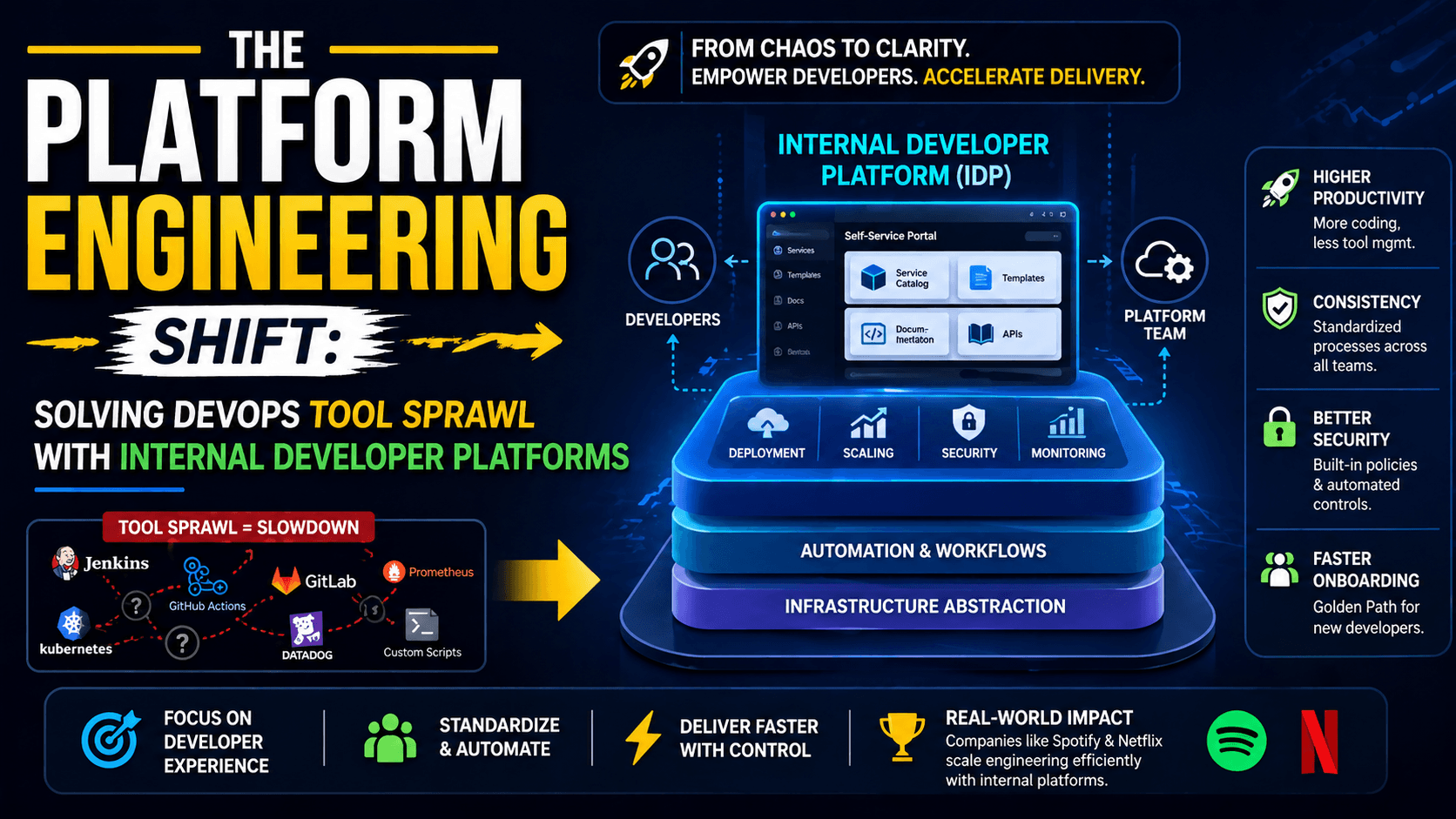
Tool sprawl happens when teams use too many disconnected tools across the software lifecycle.
- One team uses Jenkins.
- Another uses GitHub Actions.
- A third relies on GitLab pipelines.
- Monitoring might include Prometheus, Datadog, and custom scripts all at once.
The result? Fragmentation, duplication, and unnecessary complexity.
Why It Becomes a Problem
Tool sprawl doesn’t just create confusion—it directly impacts performance:
- Cognitive Load: Developers spend more time learning tools than building features.
- Maintenance Debt: Integration and maintenance become significantly harder.
- Security Risks: Security policies become inconsistent across platforms.
- Operational Friction: Debugging issues across multiple systems gets complicated.
Instead of accelerating delivery, DevOps starts slowing it down.
The Rise of Platform Engineering
Platform Engineering is the next evolution of DevOps. Instead of giving teams raw tools, organizations build internal platforms that provide ready-to-use environments.
Platform teams act like product teams designing systems focused on developer experience, usability, and consistency.
What is an Internal Developer Platform (IDP)?
An Internal Developer Platform (IDP) is a centralized system that abstracts infrastructure and tools. Developers don’t need to configure Kubernetes or pipelines manually they simply use a self-service interface.
The platform handles everything behind the scenes:
- Deployment
- Scaling
- Security
- Monitoring
Note: Tools like Backstage provide a unified developer portal to access services, workflows, and documentation.
Key Benefits
Platform Engineering solves tool sprawl by simplifying the entire workflow:
- Higher Productivity: Less tool management, more coding.
- Consistency: Standardized processes across all teams.
- Better Security: Built-in policies and automated controls.
- Faster Onboarding: New developers ramp up quickly with a "Golden Path."
Real-World Impact
Companies like Spotify and Netflix have already adopted internal platforms to scale engineering efficiently. They enable developers to deploy independently while maintaining governance—striking the perfect balance between speed and control.
Challenges to Consider
Adopting Platform Engineering isn’t just technical—it’s cultural.
- Requires significant upfront investment.
- Needs a strong understanding of developer needs.
- Risk of over-engineering if not managed properly.
The key is to build for developers, not for complexity.
Best Practices
- Start small and iterate.
- Focus on Developer Experience (DX).
- Treat the platform as a product.
- Continuously gather feedback.
Conclusion
Platform Engineering isn’t just fixing tool sprawl it’s redefining how software is built. By introducing Internal Developer Platforms, organizations can turn chaos into clarity, enabling teams to move faster without losing control.
In a world where speed and reliability matter, this shift isn’t optional—it’s inevitable.