How intelligent agents collaborate to solve complex real-world problems
Artificial Intelligence has evolved far beyond simple models that take an input and produce an output.
Today’s intelligent systems often need to:
- make decisions dynamically
- adapt to changing environments
- collaborate with other systems
- solve complex multi-step problems
- continuously improve through feedback loops
When I started exploring Agentic AI, I realized something important:
- Most real-world intelligent systems are not powered by a single AI model.
- Instead, they rely on multiple intelligent components working together.
- This concept is formally known as Multi-Agent Systems (MAS).
- Understanding MAS helps us understand how modern AI systems — including LLM-based agents — are designed to operate autonomously and intelligently.
From Single AI to Multi-Agent Intelligence
Traditional AI systems often follow a linear pipeline: Input → Processing → Output.
However, real-world problems are rarely linear and require coordination between multiple intelligent components.
What is a Multi-Agent System?
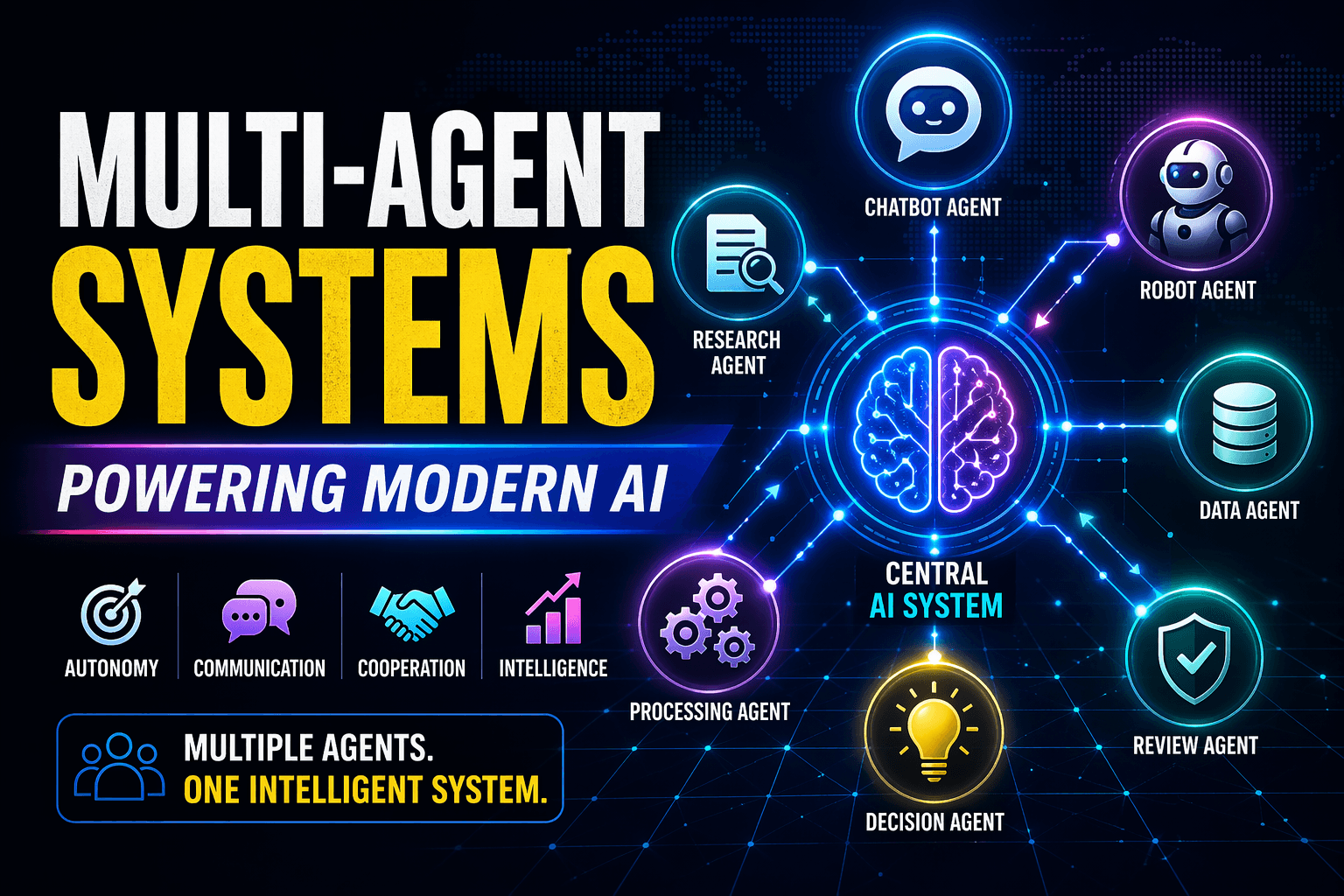
A Multi-Agent System (MAS) is a system composed of multiple intelligent entities, called agents, that interact with each other and their environment to achieve goals.
Each agent:
- perceives information
- processes knowledge
- takes actions
- communicates with other agents
Instead of one centralized intelligence solving everything, intelligence is distributed across multiple entities. This distributed nature makes MAS highly scalable and adaptable.
Understanding Agents
An agent is an entity capable of making decisions and acting autonomously. Typical loop: Perceive → Decide → Act → Learn → Repeat.
Examples of agents include:
- chatbots
- recommendation systems
- trading bots
- delivery robots
- fraud detection systems
- virtual assistants
Each agent operates independently but can also collaborate with other agents when needed.
Types of Agents:
Reactive Agents
Respond immediately to environmental changes based on predefined rules.
They do not plan ahead but react based on predefined rules.
Example:
A thermostat adjusting temperature when the room becomes too hot.
Deliberative Agents
Deliberative agents maintain an internal model of the environment and plan actions before executing them.
Example:
A chess AI evaluating possible moves before making a decision.
Hybrid Agents
Hybrid agents combine reactive and deliberative approaches.
Example:
A self-driving car must:
- react quickly to sudden obstacles
- plan optimal routes
Hybrid agents are common in real-world AI applications.
Learning Agents
Learning agents improve performance based on experience.
They use techniques such as:
- machine learning
- reinforcement learning
- neural networks
Example:
Recommendation systems improving suggestions over time.
Learning agents are essential for dynamic environments.
Key Characteristics of MAS
- Autonomy – operate independently
- Social Ability – communicate with other agents
- Reactivity – respond to environment
- Proactiveness – take initiative
Communication Between Agents
Communication is fundamental to MAS.
Agents exchange information using structured protocols.
Common communication methods include:
- message passing
- shared memory
- API calls
- event-based triggers
A typical communication flow might look like:
Agent A → sends information
Agent B → processes data
Agent C → validates result
This coordination allows the system to behave intelligently as a whole.
Cooperation and Coordination
Agents often need to coordinate actions to avoid conflicts and improve efficiency.
Consider warehouse robots moving packages.
Without coordination:
- robots may collide
- duplicate tasks may occur
- efficiency decreases
With coordination:
- tasks are distributed optimally
- collisions are avoided
- performance improves
Coordination strategies include:
- centralized control
- decentralized decision making
- negotiation protocols
Distributed Problem Solving
MAS enables distributed problem solving.
Instead of one system solving a large problem, multiple agents solve smaller parts of the problem.
Advantages:
- faster computation
- better scalability
- improved fault tolerance
Example:
Large-scale recommendation systems using multiple microservices.
Swarm Intelligence
Swarm intelligence is inspired by collective behavior in nature.
Examples include:
- ants finding shortest paths
- birds flocking
- bees locating food sources
Each individual agent follows simple rules.
However, collective behavior produces intelligent outcomes.
Algorithms inspired by swarm intelligence include:
- Ant Colony Optimization
- Particle Swarm Optimization
These algorithms are widely used in optimization problems.
Real-World Applications
- Robotics
- Autonomous Vehicles
- Smart Grid Systems
- Financial Trading Systems
- LLM-based multi-agent workflows
Connection Between MAS and Agentic AI
Agentic AI focuses on goal-driven AI systems capable of autonomous decision making.
MAS provides the structural foundation for agent collaboration.
Together, they enable:
- adaptive workflows
- intelligent automation
- iterative reasoning
- dynamic decision-making systems
Agentic AI systems often use MAS principles to orchestrate multiple agents effectively.
Example Workflow
- Planner Agent defines steps
- Research Agent gathers information
- Writer Agent generates response
- Reviewer Agent validates output
Why MAS is Important
As AI systems become more advanced, the need for modular and collaborative intelligence increases.
Single models cannot efficiently handle:
- large-scale reasoning
- complex workflows
- dynamic decision making
Multi-Agent Systems allow AI architectures to become more flexible and scalable.
They enable intelligent systems to adapt continuously.
This makes MAS an essential concept in modern AI design.
.
Key Takeaways
Multi-Agent Systems provide a framework for designing intelligent systems composed of multiple interacting entities.
Key benefits include:
- scalability
- flexibility
- robustness
- adaptability
MAS concepts are widely used in:
- robotics
- distributed computing
- optimization problems
- financial systems
- modern LLM-based AI agents
Understanding MAS provides deeper insight into how modern intelligent systems operate.
Final Thoughts
Intelligence often emerges from collaboration between multiple specialized agents rather than a single powerful model.