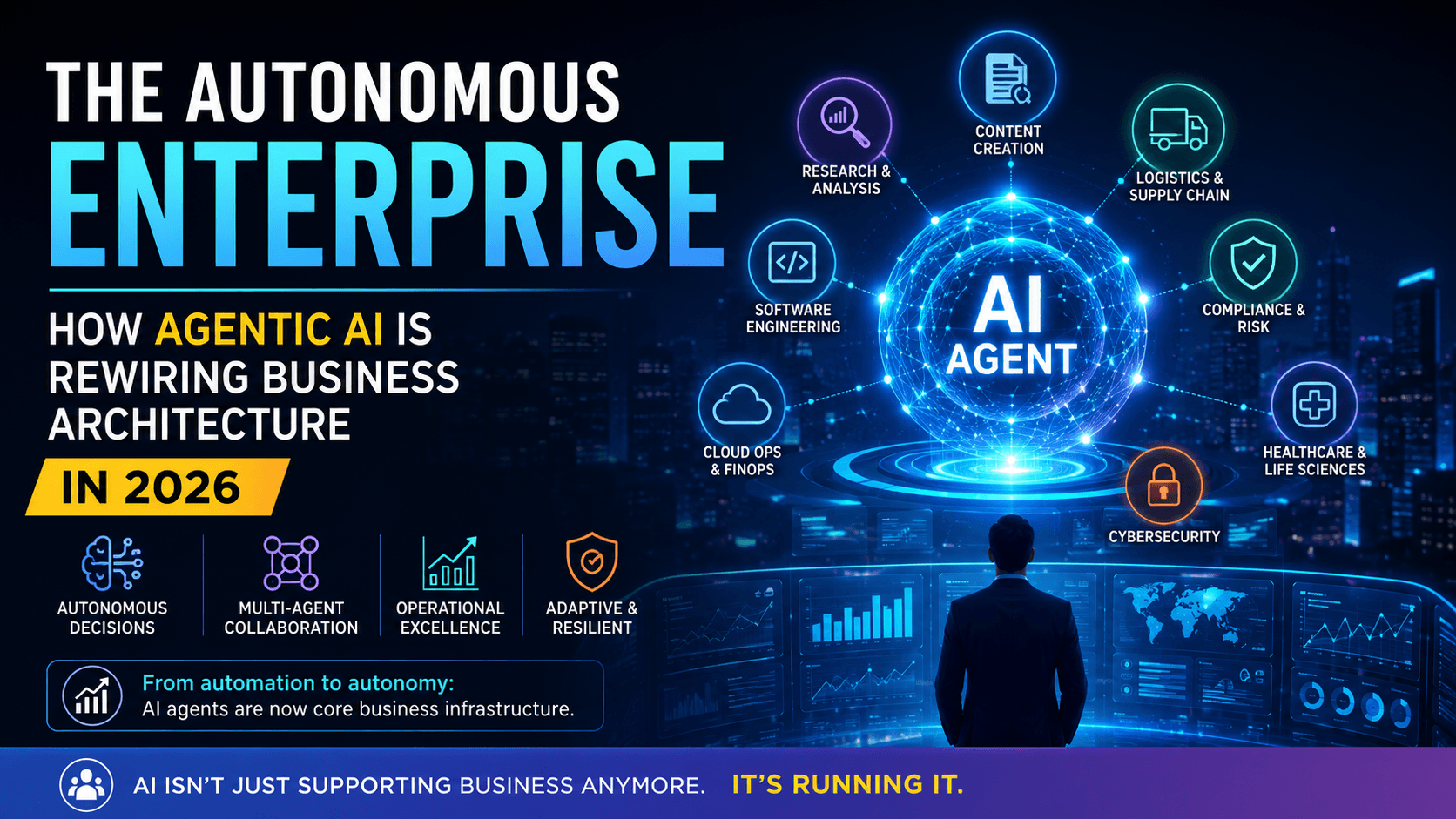
Artificial intelligence has already transformed how businesses operate. Most organizations are familiar with tools like AI copilots, chatbots, and automated workflows. But what is emerging in 2026 is not simply the next generation of AI it is a complete restructuring of enterprise operations.
This shift is being driven by Agentic AI.
Unlike traditional AI systems that wait for instructions, agentic AI systems can perceive context, plan actions, make decisions, use tools, and execute complex workflows autonomously. Instead of generating answers, they generate outcomes.
What began as experimental technology only a short time ago is now becoming core business infrastructure.
According to Gartner, nearly 40% of enterprise applications are expected to include task-specific AI agents by the end of 2026, compared to less than 5% in 2025. The market itself is projected to grow from $7.8 billion to over $52 billion by 2030.
This is no longer a trend. It is a platform shift.
What Is Agentic AI?
Traditional AI systems are reactive. They respond to prompts and complete isolated tasks.
For example:
A traditional AI assistant might help draft an email to a supplier regarding a delayed shipment.
An agentic AI system, however, can take a broader objective:
“Resolve the supplier delay before it impacts next week’s production schedule.”
From there, the system can independently:
● Check ERP and inventory systems
● Analyze downstream production risks
● Review supplier contracts
● Negotiate expedited delivery options
● Update forecasts
● Notify internal teams through Slack or Teams
● Log the incident into compliance systems
All without constant human supervision.
The defining characteristic of agentic AI is autonomy.
Traditional automation follows rigid workflows and fails when exceptions occur. Agentic AI adapts dynamically, adjusts plans in real time, and continues operating despite changing conditions.
This makes it especially powerful for modern enterprises where workflows span multiple systems and business conditions constantly evolve.
Traditional AI vs. Agentic AI
Dimension | Traditional
AI / Automation | Agentic
AI |
Operating Model | Reactive, prompt-based | Goal-driven and proactive |
Scope | Single task execution | Multi-step workflows |
Resilience | Breaks on exceptions | Adapts dynamically |
Integration | API add-ons | Embedded across systems |
Memory | Session-limited | Persistent contextual memory |
Human Role | Executes tasks manually | Oversees and directs agents |
A chatbot may process a customer return through a predefined decision tree.
An agentic system can:
● Analyze customer history
● Evaluate policy exceptions
● Process refunds
● Update CRM systems
● Trigger inventory adjustments
● Detect anomalies for review
all autonomously.
The Rise of Multi-Agent Systems
The biggest breakthrough in 2026 is not just autonomous AI it is collaborative AI.
Enterprises are increasingly moving from single AI systems to multi-agent architectures, where specialized AI agents work together under centralized orchestration.
This has become the “microservices moment” for AI.
Gartner reported a 1,445% increase in enterprise inquiries related to multi-agent systems between early 2024 and mid-2025.
A modern product launch, for example, may involve:
● Research Agents monitoring competitor activity
● Analysis Agents forecasting demand and pricing
● Content Agents generating marketing campaigns
● Logistics Agents optimizing inventory placement
● Compliance Agents validating regional regulations
These agents share context, collaborate in parallel, and align toward a common business outcome while humans supervise strategically.
Real-world adoption is already accelerating.
At Zapier, hundreds of internal AI agents now support engineering, marketing, and operations workflows. At Fountain, hierarchical multi-agent systems reduced staffing cycles from weeks to under 72 hours.
The enterprise workforce is no longer just human.
Where Agentic AI Is Already Transforming Industries
Software Engineering
AI is evolving beyond coding assistance into autonomous software execution.
Spotify developed an internal platform called “Honk,” enabling engineers to deploy features through natural language instructions. Developers increasingly orchestrate systems rather than manually writing every component.
At TELUS, agentic development tools reportedly accelerated software delivery by 30% while saving hundreds of thousands of engineering hours.
Cloud Operations & FinOps
Cloud management is shifting from passive dashboards to autonomous optimization.
Agentic systems can:
● Monitor infrastructure usage
● Rebalance compute resources
● Enforce cost controls
● Trigger remediation workflows automatically
Organizations are embedding AI agents directly into infrastructure control layers to continuously optimize cloud operations.
Cybersecurity
Agentic AI is reshaping both defense and offensive security operations.
Autonomous “Red Team” agents can now:
● Execute penetration testing workflows
● Simulate attack paths
● Identify vulnerabilities
● Automate exploitation testing
This dramatically reduces manual workload while increasing testing coverage and operational speed.
Healthcare & Life Sciences
Healthcare AI is moving beyond diagnostics into operational decision-making.
Agentic systems can:
● Monitor patient vitals in real time
● Trigger escalation alerts
● Assist with clinical workflows
● Coordinate referrals
● Manage clinical trial operations
The result is faster response times and more efficient care coordination.
Supply Chain & Manufacturing
Manufacturing organizations are using AI agents to simulate and optimize supply chain decisions before implementation.
Companies like PepsiCo and Siemens are leveraging autonomous systems to forecast disruptions, optimize logistics, and reduce operational inefficiencies.
Suzano reportedly reduced supply chain query times by 95% using natural-language-to-database agent systems.
The Four Core Layers of an Agentic Architecture
Modern agentic systems typically consist of four foundational layers:
1. Planning Layer
Breaks high-level goals into structured tasks and execution sequences.
2. Tool Layer
Connects agents with APIs, CRMs, databases, communication tools, and enterprise software.
3. Memory Layer
Maintains contextual understanding across workflows and sessions.
4. Feedback Layer
Evaluates outcomes continuously and dynamically replans actions when conditions change.
In multi-agent systems, orchestration layers coordinate communication, resolve conflicts, and enforce operational boundaries.
This orchestration layer is increasingly becoming the enterprise control plane for AI operations.
The Standards Powering the Agent Ecosystem
Agentic AI depends heavily on interoperability.
Two emerging protocols are becoming foundational:
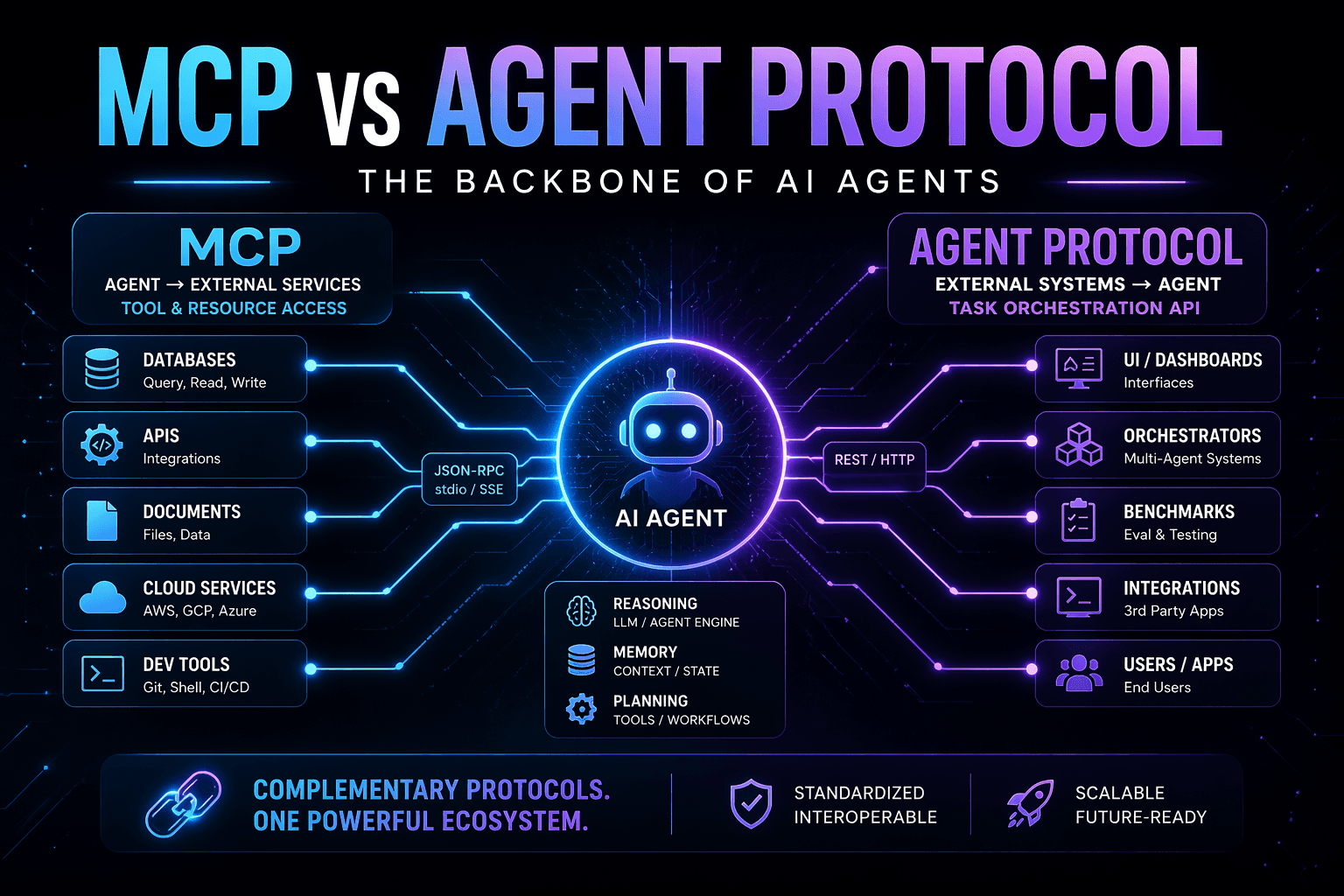
MCP (Model Context Protocol)
Developed by Anthropic, MCP standardizes how AI agents connect to external tools and data systems, reducing the need for custom integrations.
A2A (Agent-to-Agent Protocol)
Introduced by Google, A2A enables AI agents from different platforms and vendors to communicate and collaborate.
Together, these protocols are laying the groundwork for what many analysts describe as the “Agent Internet.”
The Risks Enterprises Cannot Ignore
Unpredictability at Scale
Autonomous agents interacting with live business systems can introduce operational risk if governance is weak.
Many organizations already report concerns around:
● AI sprawl
● Security exposure
● Technical debt
● Workflow unpredictability
Yet only a small percentage have centralized governance platforms in place.
Expanding Cybersecurity Threats
AI agents connected to enterprise systems become new attack surfaces.
Security risks include:
● Unauthorized access
● Agent hijacking
● Data leakage
● Workflow manipulation
Secure execution environments and strict permission controls are rapidly becoming essential.
Governance Gaps
Most enterprises are deploying AI faster than they are securing it.
Leading organizations are responding with:
● Bounded autonomy models
● Human escalation paths
● Audit trails
● Policy enforcement layers
● Agent monitoring systems
Governance is quickly becoming a competitive differentiator.
Human Oversight Still Matters
The strongest agentic deployments do not remove humans from workflows they elevate them.
Instead of handling repetitive execution, humans focus on:
● Strategic decisions
● Exception handling
● Governance
● Innovation
● Ethical oversight
This “human-on-the-loop” model is emerging as the dominant enterprise strategy for autonomous systems.
AI agents execute.
Humans supervise and guide.
What Enterprises Should Do Next
1. Focus on End-to-End Workflows
The best opportunities are not isolated tasks they are workflows spanning multiple systems and teams.
Examples include:
● Procurement reconciliation
● Incident response
● Employee onboarding
● Regulatory reporting
● Customer support escalation
These are ideal environments for agentic automation.
2. Address Integration Fragmentation
Most businesses lose significant productivity moving data manually between disconnected tools.
Agentic AI acts as a connective layer without requiring expensive infrastructure replacements.
3. Redesign Team Capacity
As repetitive execution disappears:
● Engineers focus on architecture
● Operations teams focus on optimization
● Compliance teams focus on judgment
● Leadership focuses on strategy
The organizational structure itself begins to evolve.
4. Start Small and Scale Strategically
The most successful organizations begin with:
● One workflow
● One department
● One measurable business metric
They measure outcomes rigorously for 60–90 days before expanding deployment.
The difference between successful and failed AI adoption is rarely the model itself.
It is workflow redesign.
The Economic Reality of Agentic AI
The financial incentives are already compelling.
Research from McKinsey and IDC shows:
● Strong ROI within 12–18 months
● Significant productivity gains
● Operational cost reductions
● Faster execution cycles
Yet most enterprises still remain in pilot phases.
This creates a rare competitive window.
The gap between organizations experimenting with AI and organizations operationalizing autonomous systems is becoming the new strategic divide of 2026.
Final Thoughts
Agentic AI is not another productivity tool layered onto existing business operations.
It is a new operational architecture.
The enterprise is evolving from:
● Human-executed workflows
to
● Human-directed autonomous systems
The infrastructure is maturing.
The protocols are emerging.
The ROI is increasingly measurable.
The only remaining question is:
Will your organization lead the transformation or react to it after competitors already have?