From Detection to Decision: Turning Renewable Energy Data Into Action
Renewable energy operations are becoming increasingly data-driven.
From wind turbines and solar plants to battery storage and grid infrastructure, modern energy assets continuously generate operational data through SCADA systems, sensors, ERP platforms, maintenance systems, and other enterprise applications.
But generating data is no longer the biggest challenge.
The bigger question is: Is that data actually driving action?
When Detection Is Faster Than Response
A SCADA system can detect an abnormal temperature, equipment fault, performance deviation, or other operational anomaly within seconds.
But what happens next?
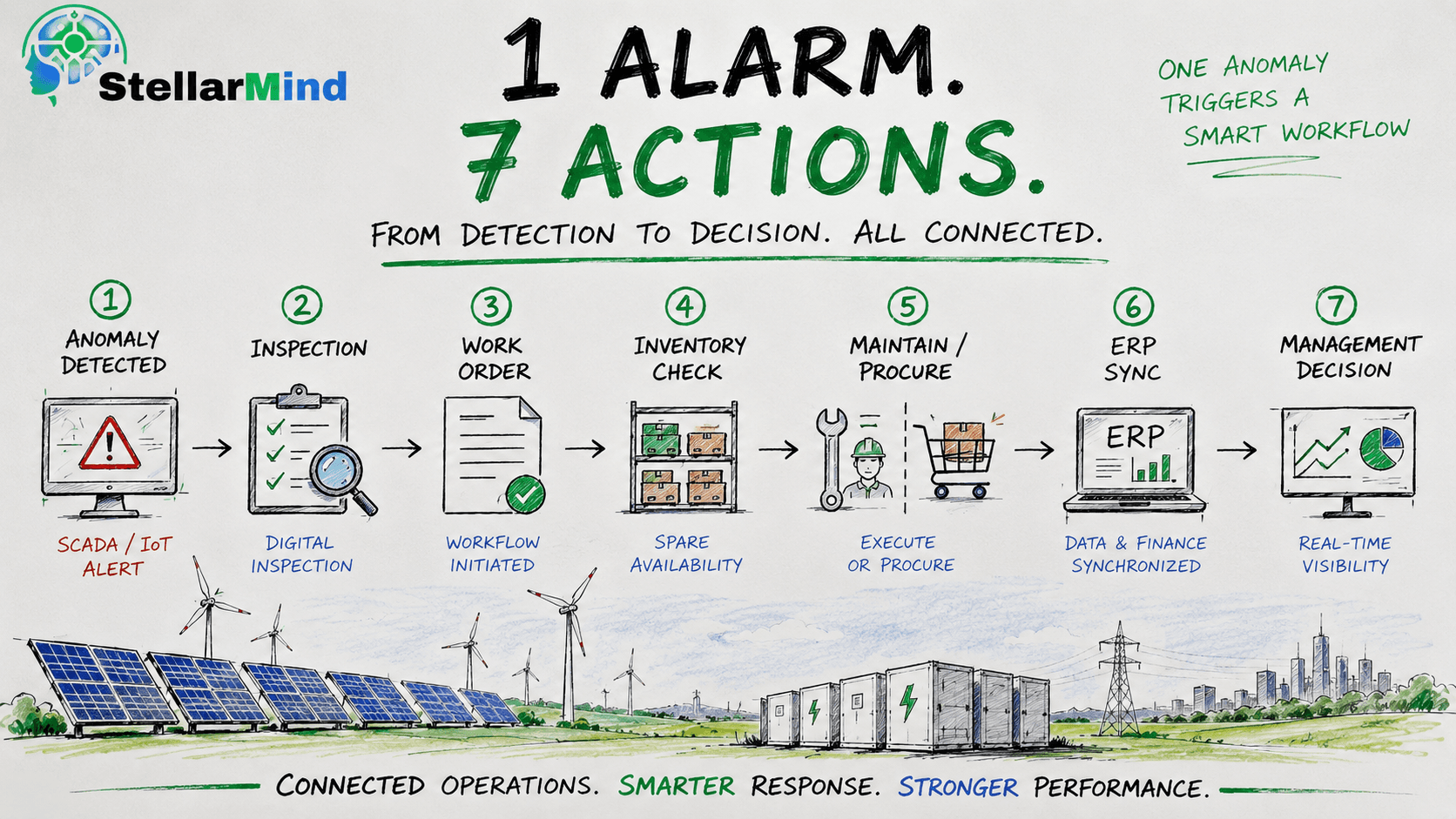
The anomaly may need to trigger an inspection. The inspection may lead to a work order. The maintenance team may need to check spare-part availability. Procurement may need to source a component. Finance and ERP systems may need to be updated. Meanwhile, management needs visibility into the issue and its potential business impact.
Each step is important.
The problem is that these steps often happen across disconnected systems and teams.
As a result, an issue detected in seconds can still take hours to coordinate.
This creates a critical gap between operational intelligence and operational execution.
The Hidden Cost of Disconnected Workflows
Consider a simple scenario.
A critical asset begins showing abnormal operating behavior.
SCADA identifies the anomaly and generates an alert.
But the alert alone does not resolve the problem.
Someone needs to interpret it. An inspection needs to be scheduled. A work order needs to be created. The maintenance team needs the right information. Required spare parts need to be checked. If inventory is unavailable, procurement may need to intervene.
At the same time, the organization may need to track:
- What happened?
- Which asset is affected?
- How critical is the issue?
- Who is responsible for the next action?
- Are the required spare parts available?
- What is the expected downtime?
- What will the maintenance activity cost?
- Has the issue been resolved?
When every step requires manual coordination between different systems, operational response becomes slower and more difficult to manage.
The problem isn't a lack of data.
The problem is the lack of connected workflows around that data.
Connecting Data With the Workflows That Follow
This is the gap we are working to solve at StellarMind.
Our approach is focused on connecting operational data with the business and operational processes that follow it.
Instead of treating SCADA, maintenance, procurement, ERP, finance, and management systems as isolated environments, the goal is to create a connected operational flow.
A single asset event can move through a coordinated process:
Detection → Inspection → Work Order → Spare Availability → Maintenance/Procurement → ERP & Finance → Management Visibility
This allows organizations to move from simply identifying an issue to coordinating the response around it.
The objective is not to replace the systems already being used.
It is to make those systems work together more effectively.
From an Alarm to an Action
The true value of operational data emerges when it can initiate the right action.
Imagine a system where an anomaly detected by SCADA can automatically become part of an operational workflow.
The relevant asset and event information can be passed to the appropriate process. An inspection can be initiated. A work order can be created. Spare availability can be checked. If inventory is insufficient, procurement can be brought into the workflow.
Meanwhile, decision-makers can see the operational impact without waiting for information to be manually consolidated across multiple systems.
This creates a continuous flow:
Operational Event → Context → Decision → Workflow → Action → Outcome
That is where data begins to create measurable operational value.
Why This Matters for Renewable Energy
Renewable energy assets operate in environments where uptime, maintenance efficiency, and asset performance directly influence operational and financial outcomes.
As renewable portfolios scale, the volume of operational events also increases.
Managing these events manually becomes increasingly difficult.
Organizations therefore need more than real-time monitoring.
They need the ability to orchestrate what happens after monitoring identifies a problem.
A connected operational layer can help reduce the friction between systems, teams, and processes—allowing organizations to respond faster while maintaining visibility across the entire lifecycle of an operational event.
Beyond Monitoring: Building an Operational Intelligence Layer
The next evolution of renewable energy technology is not simply about collecting more data.
It is about making existing data more actionable.
SCADA can tell you what is happening.
Enterprise systems can tell you what resources and processes are available.
AI and automation can help connect the two.
Together, these capabilities can create an operational intelligence layer that helps organizations move from detection to decision and from decision to execution.
This is the direction we are building toward at StellarMind.
Because the value of real-time monitoring isn't just seeing the problem earlier.
It is acting on it faster.
The Question Energy Operators Should Ask
As renewable energy operations become more connected, the key question is no longer simply:
"How quickly can we detect an anomaly?"
It is:
"How quickly can we move from an anomaly to resolution?"
The organizations that close that gap will be better positioned to improve maintenance response, reduce operational friction, and turn their growing volumes of operational data into measurable business outcomes.
How connected is your alarm-to-resolution workflow today?
Explore how StellarMind connects operational intelligence with enterprise workflows to help energy organizations move from detection to action.
#RenewableEnergy #EnergyOperations #SCADA #PredictiveMaintenance #IndustrialAI #Automation #DigitalTransformation #StellarMind