AIAutomation
Deterministic AI Enterprise Intelligence Platform
Enterprise intelligence platform combining AI and rule engines to analyze enterprise data and deliver reliable, explainable decision support.
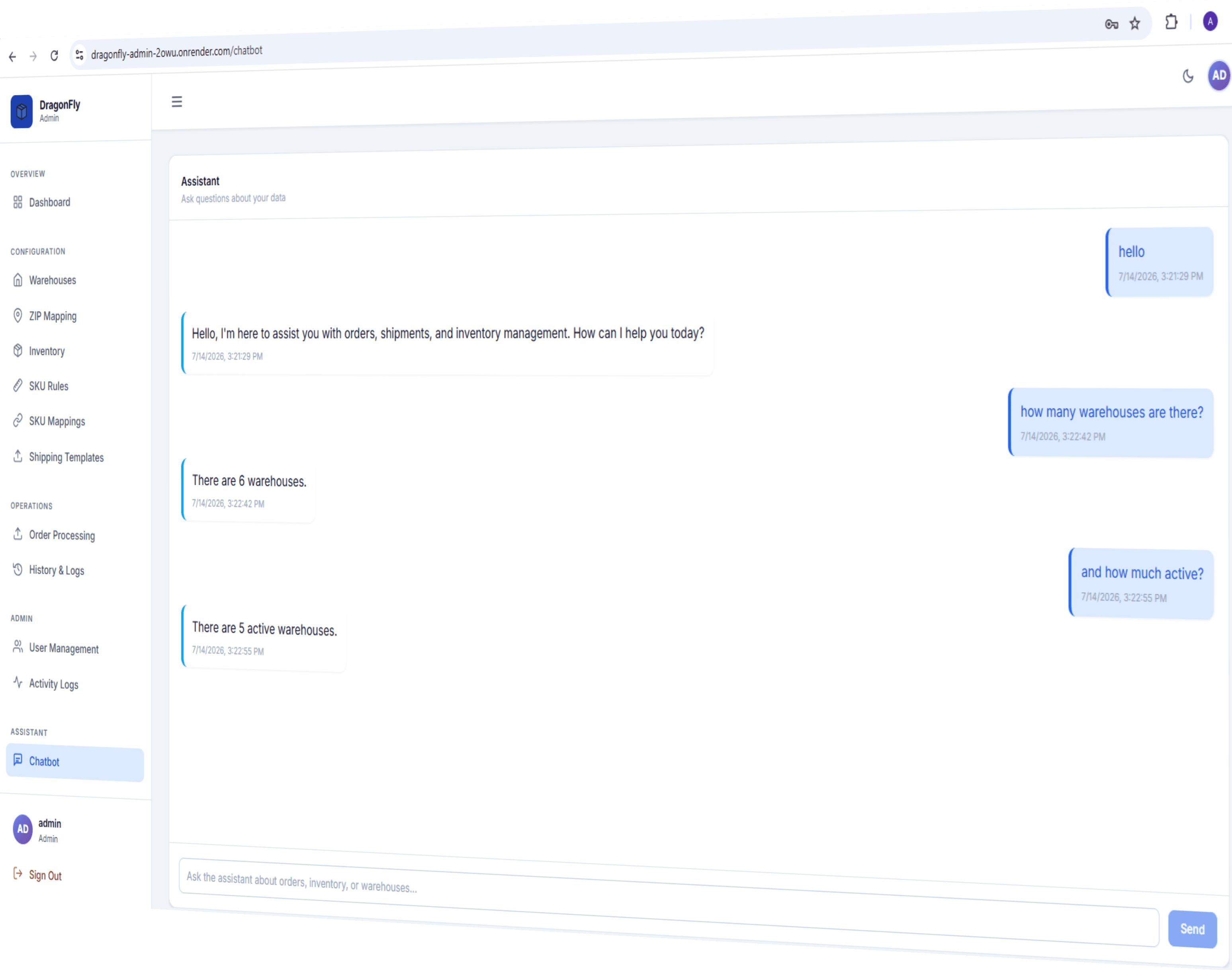
AI conversational assistant for warehouses with real-time order, inventory, and shipment insights, role-based access, and secure read-only data retrieval.
This platform is built for multi-warehouse fulfillment and logistics operations — businesses that manage inventory, orders, and shipments across one or more warehouse locations on behalf of e-commerce and marketplace sellers (for example, orders sourced from Amazon and Walmart). The organization's day-to-day operations are run by three distinct groups of people: an Owner overseeing the business across all warehouses, Warehouse Managers responsible for inventory and order operations at their site(s), and Shipping Operators handling day-to-day order fulfillment and dispatch. Like most fulfillment operations at this scale, getting a straight answer out of the operational database — "how many orders are still pending for Warehouse 3?" or "what's our available inventory on this SKU?" — traditionally meant writing a SQL query, waiting on a developer, or digging through a fixed dashboard report that didn't quite answer the actual question being asked. As the business grows across more warehouses and more staff need visibility into operational data, the organization needed a way to give every role — owner, manager, and operator — instant, appropriately scoped answers without adding engineering overhead or risking any of them accidentally changing live data.









Getting a simple operational answer — order counts, inventory levels, shipment status — required SQL knowledge, a BI tool, or a request routed to engineering, slowing down everyday decisions on the warehouse floor and in the front office.

Giving every staff member full database access created an unacceptable security and data-integrity risk, while restricting access to a handful of technical staff created a bottleneck that slowed the whole organization down.

Fixed dashboards and reports could show a snapshot, but staff couldn't naturally ask a follow-up question — "and how many of those are still unassigned?" — without rebuilding a query.

Warehouse owners were, rightly, cautious about connecting any AI system to live operational data — a single incorrect or malicious query could alter or delete real order, inventory, or shipment records.

Every fulfillment operation structures its SKUs, warehouses, and routing rules differently, so a generic reporting tool couldn't be dropped in without significant custom rework for each new site or client.
To address these challenges, we built a Role-Based Conversational Data Platform that answers every operational question instantly, enforces strict data-access boundaries automatically, and guarantees at an architectural level that it can never modify the underlying data.

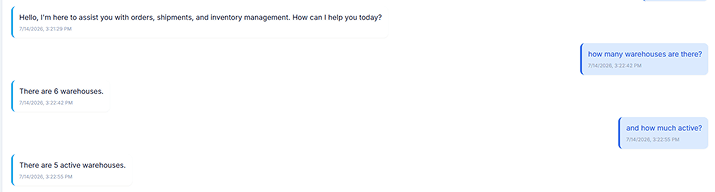
Staff simply type a question in plain English — "How many orders are still pending for the East Coast warehouse?" or "Show me shipments that haven't shipped yet." The system first classifies the intent of the message (a greeting, a help request, or an actual data question) so the conversation feels natural rather than like filling out a rigid form, and only runs the full data pipeline when a real question is being asked.

Before any question is even processed, the system determines what the requesting user's role — Owner, Warehouse Manager, or Shipping Operator — is permitted to see, and builds a compressed, role-specific view of the database schema. The AI is never shown tables or columns outside that role's permissions, so restricted data is structurally invisible to it rather than merely hidden by the interface.

The natural-language question is translated into a precise, read-only database query. That query is then independently re-checked by a dedicated SQL validation engine that blocks any operation other than a single, safe data-retrieval statement and confirms it only touches tables the user's role is allowed to access — a second, AI-independent checkpoint that doesn't rely on trusting the language model alone.

If a generated query fails validation or execution — an ambiguous phrasing, an edge case in the data — the system automatically diagnoses the specific issue and retries with a corrected query, up to a configurable retry limit, before ever falling back to a safe, plain-language message. Staff experience this as the assistant simply getting the right answer, without ever seeing a technical error.

The system remembers recent questions and answers within a session, so users can naturally follow up — "and how many of those are still unassigned?" — without repeating context, much like asking a colleague a second question in the same conversation.

Every order, inventory record, shipment, and warehouse routing rule is served from a single PostgreSQL database (with support for modern serverless Postgres infrastructure), accessed exclusively through read-only sessions with enforced query timeouts and row limits — giving the business one reliable source of truth with no path for the assistant to write, alter, or delete data.

A new warehouse client's schema, roles, and permissions are defined through configuration rather than custom code, so onboarding a new site or client's data model and team structure is a configuration exercise rather than a rebuild — directly supporting a fast, repeatable rollout process.
The Role-Based Conversational Data Platform delivered significant operational and technical advantages across the business.
Because the system is read-only by architecture and every query passes an independent safety check, there is no path — accidental or otherwise — for a conversation to alter or delete operational data.
Owners, managers, and operators get accurate operational answers immediately, without waiting on IT, a report rebuild, or a dashboard update.
Owners see the full business across every warehouse, Warehouse Managers see their site's operational data, and Shipping Operators see exactly what they need to fulfill and ship orders — the same system serving every role correctly, automatically.
Because roles and schema are configuration-driven, extending the platform to a new warehouse or a new fulfillment client is a fast configuration exercise rather than a custom engineering effort.
Staff can ask a question and then naturally refine or follow up on it, the way they would with a knowledgeable colleague, instead of rebuilding a filter or report from scratch.
Every question, generated query, and response is available for logging and review, supporting operational oversight and compliance requirements.
The pipeline uses different AI models tuned per task — a stronger model for interpreting questions, a faster model for phrasing answers — balancing accuracy, speed, and cost as usage grows across more warehouses and more concurrent users.
Explore other projects we've delivered
Enterprise intelligence platform combining AI and rule engines to analyze enterprise data and deliver reliable, explainable decision support.

Discover how a digital performance management platform unified manufacturing data, automated reporting, improved operational visibility, and enabled real-time decision-making.

AI-driven crypto trading platform using autonomous agents for market analysis, explainable trade decisions, DEX execution, and on-chain audit trails.