Supply chains have become more complex than ever before. Businesses must balance customer demand, supplier performance, inventory levels, transportation costs, and global disruptions—all while delivering products faster and more efficiently.
Traditional supply chain management often depends on manual planning, spreadsheets, and reactive decision-making. While these methods have worked for years, they struggle to keep pace with today's rapidly changing business environment.
Artificial Intelligence (AI) is transforming supply chain operations by enabling organizations to make faster decisions, predict future demand, automate routine tasks, and gain real-time visibility across the entire supply chain.
Rather than replacing human expertise, AI empowers supply chain teams to work smarter, reduce operational risks, and build more resilient supply networks.
Why Traditional Supply Chains Face Growing Challenges
Modern supply chains generate enormous amounts of data from suppliers, warehouses, logistics partners, ERP systems, IoT devices, and customers.
Without intelligent systems, organizations often face:
- Inaccurate demand forecasting
- Inventory shortages or overstocking
- Delayed procurement decisions
- Rising transportation costs
- Limited operational visibility
- Manual reporting and planning
- Slow response to supply chain disruptions
These challenges directly impact profitability, customer satisfaction, and business growth.
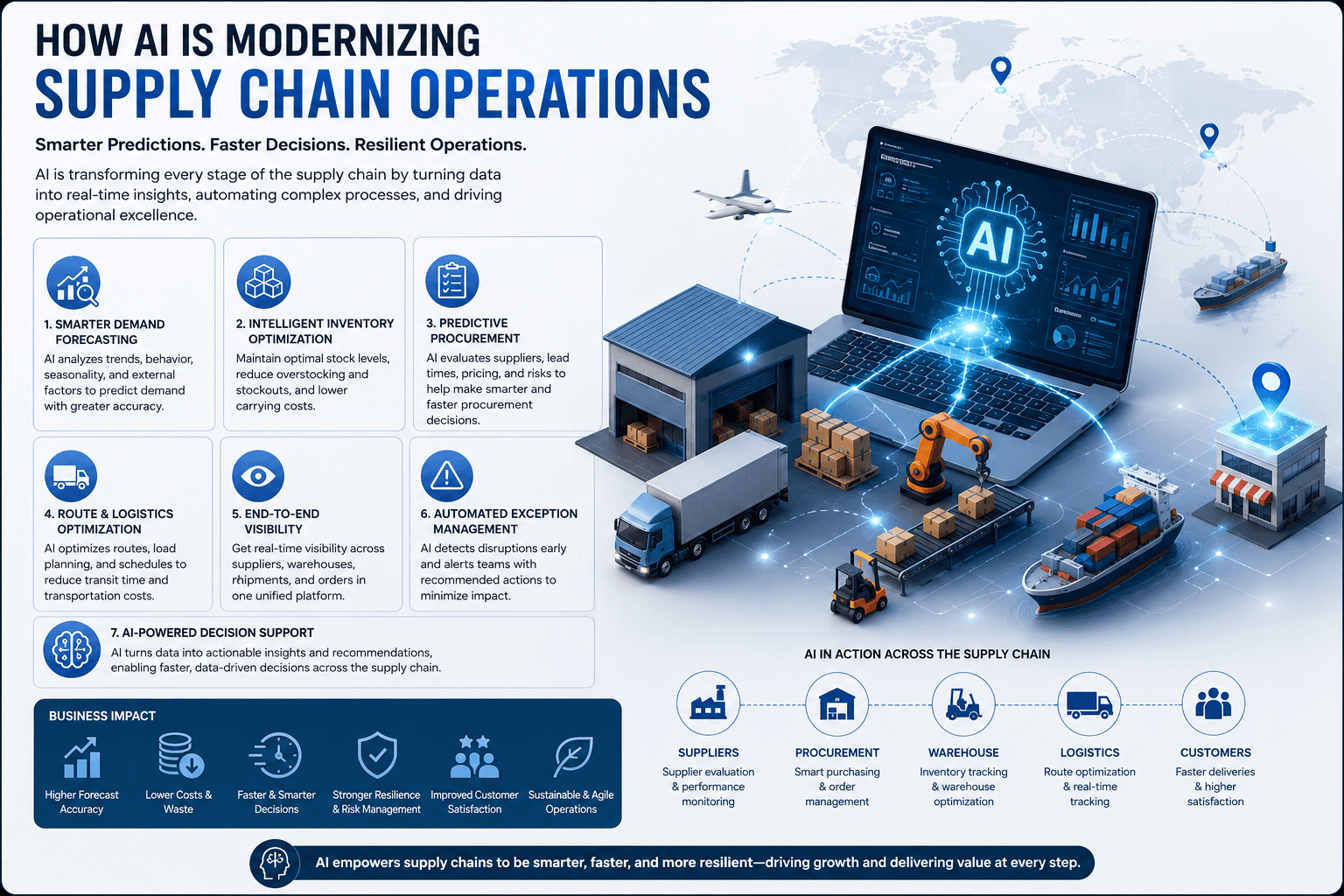
1. Smarter Demand Forecasting
One of AI's most valuable applications is predicting future demand with greater accuracy.
Instead of relying solely on historical sales data, AI analyzes multiple factors, including:
- Seasonal trends
- Customer purchasing behavior
- Market conditions
- Promotional campaigns
- Economic indicators
- Weather patterns
- Historical demand fluctuations
More accurate forecasts help organizations optimize inventory, reduce waste, and improve product availability.
2. Intelligent Inventory Optimization
Maintaining the right inventory levels is a constant challenge.
Excess inventory increases storage costs, while insufficient stock leads to lost sales and production delays.
AI continuously analyzes inventory movement to recommend optimal stock levels, helping businesses:
- Prevent stockouts
- Reduce excess inventory
- Improve warehouse utilization
- Lower carrying costs
- Increase inventory turnover
This enables companies to balance supply with customer demand more effectively.
3. Predictive Procurement
AI helps procurement teams move from reactive purchasing to proactive planning.
By evaluating supplier performance, historical purchasing data, lead times, pricing trends, and market conditions, AI can identify the best time to place orders and recommend reliable suppliers.
Benefits include:
- Improved supplier selection
- Reduced procurement risks
- Better cost control
- Faster purchasing decisions
- Stronger supplier relationships
Organizations can make data-driven procurement decisions rather than relying on manual analysis.
4. Route and Logistics Optimization
Transportation accounts for a significant portion of supply chain costs.
AI-powered logistics systems analyze traffic conditions, delivery schedules, fuel consumption, shipment priorities, and vehicle capacity to optimize transportation routes.
This leads to:
- Faster deliveries
- Lower fuel costs
- Improved fleet utilization
- Reduced transportation delays
- Better on-time performance
Real-time optimization enables logistics teams to adapt quickly to changing conditions.
5. End-to-End Supply Chain Visibility
Many businesses struggle because operational data is spread across multiple systems.
AI integrates information from ERP platforms, warehouse management systems, procurement software, IoT devices, and logistics providers to create a unified view of the supply chain.
Decision-makers gain real-time insights into:
- Inventory status
- Purchase orders
- Supplier performance
- Shipment tracking
- Warehouse operations
- Delivery performance
Greater visibility enables faster and more informed decision-making.
6. Automated Exception Management
Supply chain disruptions are inevitable, but responding quickly is what makes the difference.
AI continuously monitors operations and automatically identifies unusual events, such as:
- Delayed shipments
- Inventory shortages
- Supplier performance issues
- Unexpected demand spikes
- Warehouse bottlenecks
Instead of waiting for manual intervention, operations teams receive real-time alerts and recommended actions to minimize business impact.
7. AI-Powered Decision Support
Modern supply chain leaders need more than dashboards—they need actionable insights.
AI analyzes vast amounts of operational data to provide recommendations such as:
- Which supplier offers the best value?
- Which inventory should be replenished first?
- Which orders require priority?
- Where can transportation costs be reduced?
- Which products are likely to face stock shortages?
This helps organizations make faster, data-driven decisions with greater confidence.
The Business Benefits of AI in Supply Chain Operations
Organizations adopting AI-driven supply chain solutions often experience:
- Improved demand forecasting accuracy
- Reduced inventory costs
- Faster procurement cycles
- Increased operational efficiency
- Better supplier collaboration
- Lower logistics expenses
- Enhanced customer satisfaction
- Greater resilience during disruptions
By automating repetitive tasks and providing intelligent recommendations, AI allows teams to focus on strategic initiatives that drive business growth.
Looking Ahead
The future of supply chain management is intelligent, connected, and increasingly autonomous.
As AI continues to evolve, organizations will move beyond automation toward predictive and adaptive supply chains capable of responding to disruptions in real time. Technologies such as machine learning, computer vision, IoT, and generative AI will play a central role in improving visibility, efficiency, and resilience across global operations.
Businesses that invest in AI today will be better equipped to optimize costs, improve service levels, and build agile supply chains ready for the challenges of tomorrow.